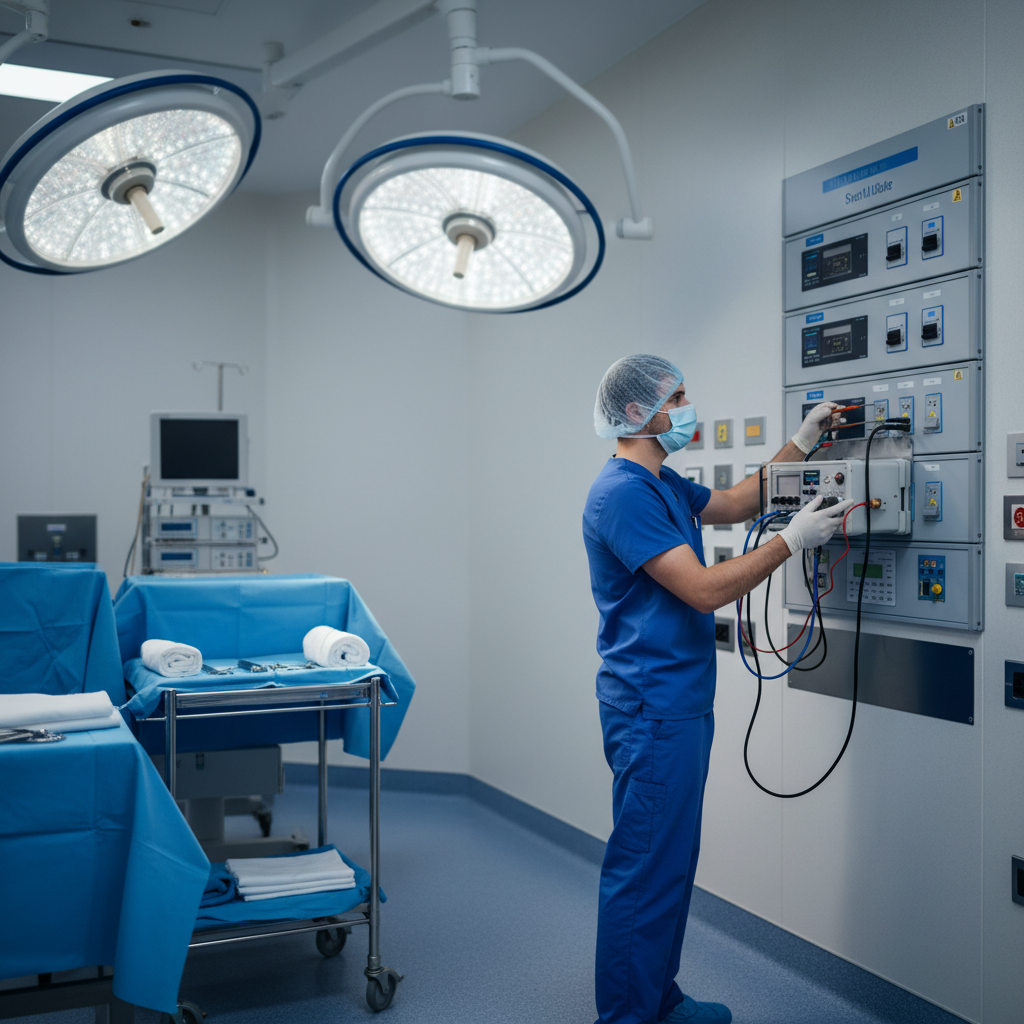
Line Isolation Monitor Inspection Philadelphia PA: NFPA 99 Compliance
Operating rooms, cardiac catheterization suites, and intensive care units in Philadelphia hospitals depend on isolated power systems (IPS) to protect patients and surgical teams from electric shock. At the heart of every isolated power system is the Line Isolation Monitor (LIM), a critical instrument continuously calculating total hazard current and alerting clinicians before a microshock or macroshock condition can occur. Without routine verification, drift, component wear, and mechanical degradation can cause a LIM to fail silently, creating immediate life-safety liabilities.
Medical Testing Solutions (MTS) delivers comprehensive line isolation monitor testing and certification throughout Philadelphia, PA, and the broader Delaware Valley. Whether your facility operates in University City, Center City, North Philadelphia, or suburban healthcare corridors, our ASSE-certified technicians execute rigorous field evaluations under NFPA 99 Chapter 6 and NFPA 70 Article 517 standards. This guide covers technical LIM requirements, testing procedures, documentation protocols, and how to maintain continuous Joint Commission (TJC) and Pennsylvania Department of Health compliance.
What Is a Line Isolation Monitor (LIM)?
An Isolated Power System (IPS) ungrounds electrical branch circuits feeding wet procedure locations and critical patient care areas. Unlike standard grounded power systems where current can travel through an inadvertent human ground path, an ungrounded circuit requires two distinct fault conditions before dangerous current can complete a circuit through human tissue.
The Line Isolation Monitor (LIM) continuously measures the impedance from each line conductor of an isolated power system to ground. Through analog or microprocessor-driven circuitry, the monitor continuously calculates the Total Hazard Current (THC). THC represents the maximum current that would flow through a low impedance connected between either isolated line and ground.
If stray capacitive leakage, compromised device insulation, or fluid ingress pushes the THC above the established threshold, typically 5.0 milliamperes (mA) for older units or 2.0 mA/5.0 mA for modern digital units, the LIM immediately activates local visual and audible alarms. It does not cut power to the life-support or surgical machinery; instead, it alerts clinical personnel that the system has lost its isolated status and is behaving like a standard grounded circuit.
Regulatory Framework: NFPA 99, NFPA 70, and Joint Commission Standards
Healthcare electrical safety is strictly governed by state, local, and national electrical codes. In Philadelphia, acute care hospitals, ambulatory surgical centers (ASCs), and specialty surgical facilities must adhere to multiple overlapping mandates.
NFPA 99 Chapter 6: Electrical Systems
NFPA 99 (Health Care Facilities Code, 2012, 2018, 2021, and 2024 editions) establishes baseline performance and maintenance criteria for isolated power systems in Category 1 (critical care) spaces:
- Section 6.3.2.6 (Isolated Power Systems): Outlines physical parameters, transformer construction, and line isolation monitor specifications.
- Section 6.3.2.6.3.2: Dictates that the monitor hazard current of a modern LIM must not exceed 1.0 mA (or 2.0 mA in legacy installations).
- Section 6.3.3.3.2 (Periodic Testing): Requires testing of line isolation monitors at regular intervals to confirm that visual and audible alarms trigger at the exact preset leakage values.
Why This Matters for Compliance:
The Centers for Medicare & Medicaid Services (CMS) and The Joint Commission enforce the 2012 edition of NFPA 99 under Conditions of Participation. An uninspected or undocumented LIM failure in an operating room is classified as an immediate Category 1 life-safety deficiency during unannounced environment-of-care surveys.
NFPA 70 Article 517: Health Care Facilities
The National Electrical Code (NEC) covers the installation of isolated power systems:
- NFPA 70 Article 517.160: Mandates the design, operating voltage, circuit breaker configurations, and installation of line isolation monitors in wet procedure locations.
- 517.160(B)(1): Specifies that the LIM shall be designed to operate with an internal impedance such that the total hazard current does not exceed 1 mA when connected to an ungrounded circuit.
Philadelphia Fire Code and PA Department of Health Title 28
The Philadelphia Department of Licenses and Inspections (L&I) adopts modern NFPA building codes. Additionally, the Pennsylvania Department of Health (Title 28, Chapter 141) requires all hospital operating suites and recovery rooms to adhere to rigorous safety protocols. Comprehensive line isolation monitor testing provides legal verification that clinical power meets both municipal and state life-safety rules.
When Is an Isolated Power System Required in Healthcare?
Not every hospital room requires an isolated power system. Facility directors, biomedical engineers, and compliance officers must differentiate between standard patient rooms and spaces requiring specialized protection.
Wet Procedure Locations (NFPA 99 § 6.3.2.3)
Operating rooms are classified as wet procedure locations by default unless a formal risk assessment is conducted by the facility's safety committee:
- Operating Theaters: Blood, irrigation fluids, and conductive liquids pool on floors around surgical tables, raising the risk of macroshock from compromised electrosurgical units (ESUs) or fluid-warming systems.
- Cardiac Catheterization Laboratories: Intravascular catheters and intracardiac probes introduce microshock vulnerability directly to the myocardium, where currents as low as 10 to 50 microamperes (µA) can trigger ventricular fibrillation.
- Hybrid Operating Suites: Large-scale robotic imaging systems, mobile fluoroscopy C-arms, and cardiopulmonary bypass pumps increase cumulative leakage capacitance, making real-time LIM monitoring critical.
If a hospital relies on a Ground Fault Circuit Interrupter (GFCI) in a wet procedure location, a single ground fault trips the breaker, plunging life-support equipment into darkness. An isolated power system avoids this hazard: the circuit stays energized during a primary fault while the LIM triggers an alert so staff can isolate the faulted equipment safely.
Anatomy of an ASSE-Certified LIM Inspection
Medical Testing Solutions approaches every line isolation monitor inspection as an exacting diagnostic procedure. Our certified field specialists do not simply push the external test button on the face of the monitor. Pushing the faceplate button only tests internal mechanical trip relays; it does not evaluate calibration drift, total system impedance, external leakage, or line-to-ground sensitivity.
Step 1: Physical Assessment and Panel Inspection
Technicians inspect the physical isolated power panel (typically manufactured by PG LifeLink, Schneider Electric/Square D, Bender, or Amsco):
- Verify environmental cleanliness, absence of dust/debris, and secure thermal seals.
- Inspect the isolation transformer for excessive heat, mechanical hum, or insulation breakdown.
- Ensure terminal connections, grounding buses, and equpotential grounding lugs are torqued to manufacturer specifications.
Step 2: Line-to-Ground Hazard Current Calibration Testing
Using calibrated test equipment (such as external dynamic resistance/capacitance decade boxes), technicians inject known resistive and capacitive leakage current from Line 1 to Ground and Line 2 to Ground:
- Resistive Fault Testing: Verify that the LIM triggers both its red flashing indicator and audible alarm within ±10% of its preset setpoint (either 2.0 mA or 5.0 mA).
- Capacitive Fault Testing: Confirm that real-world cable capacitance will not blind the monitor or generate false-trip alarms under inductive surgical loads.
- Trip Point Verification: Confirm exact threshold values where the green "SAFE" lamp extinguishes and the red "HAZARD" lamp illuminates.
Step 3: Audible and Visual Alarm Verification
Technicians evaluate the alarm system:
- Check that the audible silence button silences the horn while retaining a steady visual warning light.
- Verify that downstream remote annunciators (mounted in clinical nurse stations or surgical control booms) mirror the primary panel's alarm states accurately.
- Measure decibel levels of the audible alarm to verify audibility above surgical noise (suction, smoke evacuators, laminar airflow).
Step 4: Receptacle Ground Integrity and Retention Testing
NFPA 99 § 6.3.3.2 mandates verification of all isolated power receptacles served by the panel:
- Contact Tension Testing: Measure the mechanical retention force of each spring contact (Line, Neutral, and Ground) using calibrated mechanical weight pull-testers to ensure plugs do not dislodge mid-procedure.
- Ground Resistance Testing: Measure impedance from the receptacle ground pin to the panel's reference grounding bus (must remain under 0.1 ohms).
- Voltage Drop and Polarity Verification: Verify correct line-to-line potential (typically 120V) and confirm minimal potential difference from neutral-ground pathways.
Technical Comparison: Analog vs. Digital LIM Architectures
Hospitals across Philadelphia feature a mix of legacy analog installations and modern microprocessor-controlled digital monitors. Understanding the operational differences between these technologies informs upgrade planning and preventive maintenance schedules.
| Parameter / Feature | Legacy Analog LIMs (Pre-1995) | Microprocessor Digital LIMs (Modern) |
|---|---|---|
| Typical Manufacturers | Square D, Federal Pacific, Amsco, Sola | Bender, PG LifeLink, Schneider Electric |
| Trip Setting Range | 2.0 mA fixed or 5.0 mA fixed | 2.0 mA to 5.0 mA programmable |
| Hazard Current Display | Analog needle gauge (0–5 mA) | Digital LCD/OLED numerical display |
| Internal Monitor Hazard Current (MHC) | High (up to 1.0 mA to 2.0 mA) | Low (< 25 µA to 50 µA) |
| Capacitive Leakage Rejection | Poor (prone to false alarms from long conduits) | Advanced digital filtering (measures pure resistive leakage) |
| Remote Annunciation | Hardwired multi-conductor dry contacts | Modbus, BACnet, Ethernet, or digital bus |
| Self-Diagnostic Testing | Manual push-to-test only | Continuous internal algorithmic self-checks |
| Code Status under NFPA 99 | Conditional grandfathering; replacement recommended | Fully compliant with current NFPA 99 / NFPA 70 |
Modern digital monitors dramatically reduce false trips caused by extensive electrical wiring branch lengths. If your Philadelphia facility still runs analog needle monitors, Medical Testing Solutions can perform on-site conversions to modern digital LIMs without replacing the entire panel enclosure.