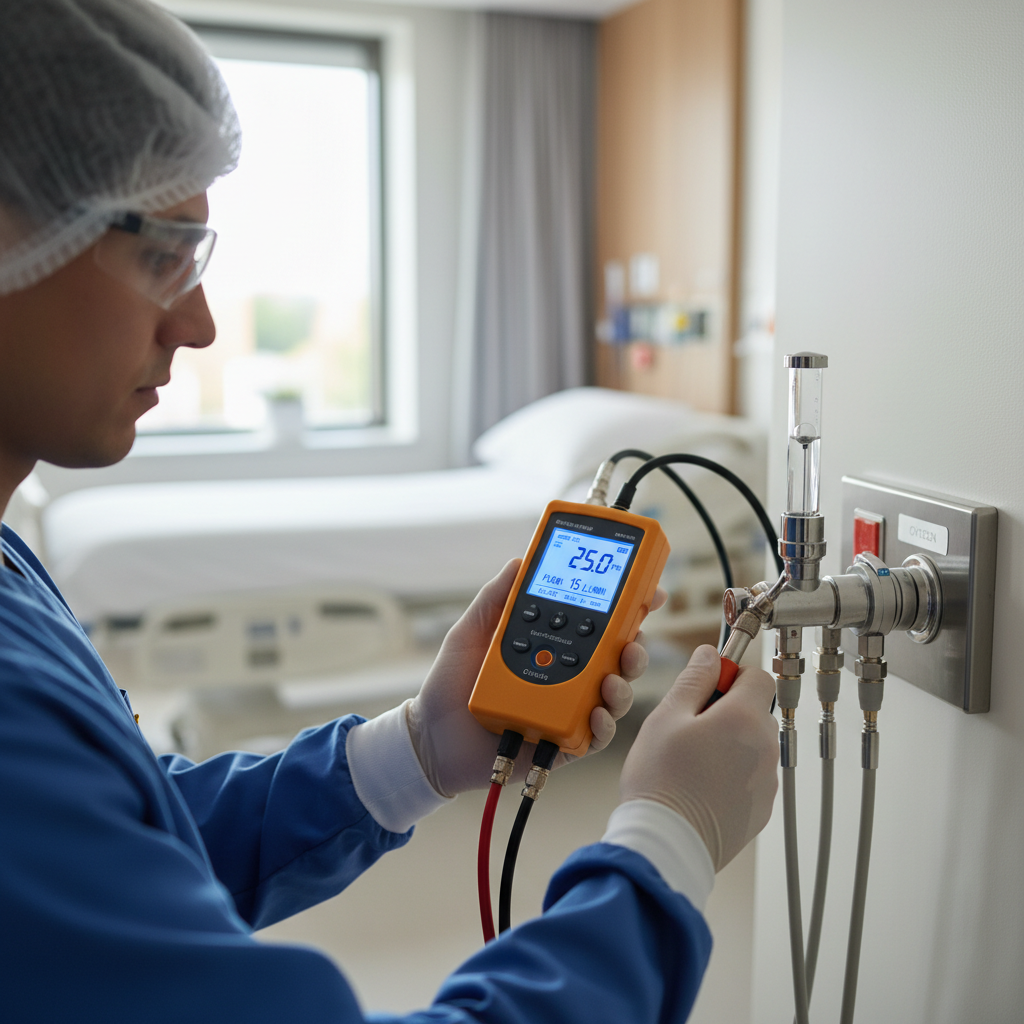
How to Test Medical Gas Outlets NFPA 99: The Complete Compliance Guide
Medical gas terminal units, commonly called medical gas outlets and inlets, serve as the critical interface between life-support pipeline infrastructure and clinical patient care equipment. When a clinician connects a flowmeter or ventilator, they rely on immediate delivery of the correct gas at adequate dynamic pressure and flow. Testing these terminal units is not merely good maintenance practice; it is a strict mandate under NFPA 99 (Health Care Facilities Code).
In this technical guide, you will learn how to test medical gas outlets NFPA 99 requirements mandate across Category 1 and Category 2 healthcare facilities. We break down the required mechanical checks, dynamic flow and pressure drop evaluations, cross-connection prevention, transient pressure limits, and leak testing criteria specified by NFPA 99 (Chapter 5) and ASSE 6000 standards. Whether you manage healthcare facility operations or prepare for routine compliance, this guide provides the exact testing protocols your biomedical and plant operations teams need.
Why Medical Gas Outlet Testing Governs Patient Safety and NFPA 99 Compliance
In a medical facility, the gas outlet is the final mechanical barrier protecting the patient. A degraded spring, dried elastomer O-ring, mechanical deformation of indexing pins, or particulate build-up inside the poppet assembly can cause catastrophic system failures.
NFPA 99 classifies medical piped gas and vacuum systems into Categories based on patient risk:
- Category 1 (Critical Care): Activities or equipment whose failure is likely to cause major injury or death to patients or caregivers.
- Category 2 (General Care): Activities or equipment whose failure is likely to cause minor injury.
Why this matters for compliance:
The Joint Commission (TJC), DNV, and local AHJs (Authorities Having Jurisdiction) cross-reference NFPA 99 requirements during triennial and annual surveys. Outlets exhibiting high dynamic pressure drops, cross-indexed connections, or excessive leaks directly trigger Environment of Care (EC) citations. Ensuring documented annual testing by certified technicians protects facility accreditation and patient life.
Medical Testing Solutions (MTS) performs nationwide evaluations through our annual medical gas inspections to assist healthcare facilities in maintaining pristine, audit-ready NFPA 99 compliance records.
NFPA 99 and ASSE 6000 Standards Governing Terminal Units
Medical gas outlet evaluation is governed by two complementary standards:
- NFPA 99 (Health Care Facilities Code): Sets installation, performance, safe maintenance, and testing criteria for piping, valves, terminal units, and source systems. Specifically, Chapter 5 details both initial verification parameters (Section 5.1.12.3) and continuing maintenance/operational criteria.
- ASSE Series 6000 (Professional Qualifications Standard for Medical Gas Systems Personnel): Governs the credentials of individuals interacting with these life-support systems:
- ASSE 6010: Medical Gas Systems Installers.
- ASSE 6030: Medical Gas Systems Verifiers (mandatory for commissioning new or renovated pipeline systems).
- ASSE 6040: Medical Gas Systems Maintenance Personnel.
Terminal units must also comply with manufacturing guidelines established by the Compressed Gas Association (CGA). Outlets utilize non-interchangeable connections, such as Diameter Index Safety System (DISS), Quick-Connect (Chemetron, Ohmeda, Puritan-Bennett, Schrader), or Geometric Keying, to physically prevent gas cross-connections.
Required Tools and Calibrated Test Equipment
Testing outlets to NFPA 99 parameters requires calibrated apparatus capable of measuring gas flow, static pressure, dynamic delivery pressure, and micro-leakage. Standard equipment includes:
- Calibrated Digital Pressure Gauges: High-accuracy digital test gauges rated to ±0.25% or ±0.1% full scale across positive pressure (0–100 psig) and vacuum/WAGD (0–30 inHgV).
- Calibrated Orifice Flow Meter / Multi-Gas Mass Flow Meter: Devices fitted with specific calibrated orifices or mass flow sensors capable of measuring continuous volumetric delivery rates (e.g., standard cubic feet per minute - SCFM, or liters per minute - LPM).
- Gas-Specific Test Adapters: Precision mating probes matching the site's outlet styles (DISS, Chemetron, Ohmeda diamond, etc.).
- Certified Leak Detection Fluid: Must be non-toxic, non-staining, and approved for oxygen systems (must meet ASTM G93 and contain no hydrocarbons, oils, or ammonia).
- Thermal Ultrasonic Leak Detector: For identifying non-audible micro-leakage behind wall plates or along internal secondary poppet seals.
- Gas Identification Analyzers: Paramagnetic oxygen analyzers and 4-gas or multi-gas infrared analyzers to verify gas purity and identity at each terminal.
Step-by-Step: How to Test Medical Gas Outlets Under NFPA 99
NFPA 99 dictates structured testing protocols for medical gas outlets and vacuum inlets. Below is the technical field procedure applied during verification and annual system audits.
Step 1: Visual Inspection and Mechanical Integrity Verification
Before attaching any pneumatic test rig, inspect the external assembly:
- Labeling & Color Coding: Confirm that the outlet faceplate and rough-in block indicate the correct gas name and standard color code (e.g., Medical Oxygen: Green in USA/CGA; Medical Air: Yellow; Vacuum: White; Nitrous Oxide: Blue).
- Physical Condition: Inspect the chrome faceplate, release mechanism, latching pins, and threaded fittings for burrs, mechanical distortion, cracks, excessive wear, or foreign contaminants.
- Gas-Specific Non-Interchangeability: Verify that latch pins or DISS thread dimensions align strictly with CGA specifications. A medical air adapter must never seat, lock, or actuate an oxygen outlet valve.
Step 2: Mechanical Latch Engagement and Secondary Check Operation
Medical gas outlets feature a primary valve (actuated when the adapter is inserted) and an internal secondary check valve (poppet seal that closes when the primary assembly is removed for servicing):
- Insert the gas-specific adapter smoothly. The adapter should click or thread positively into place without binding or requiring excessive force.
- Gently pull on the adapter to test mechanical retention. The latch pin or threaded collar must withstand axial tension without unseating or releasing gas.
- Disengage the latch mechanism. The probe must eject cleanly, and the internal primary poppet must snap forward onto its seat immediately, shutting off gas flow completely without continuous hissing.
Step 3: Static Pressure Verification
Measure the system pressure when the outlet is dormant (no gas drawing from the port):
- Connect the calibrated pressure gauge using the gas-specific adapter with the downstream discharge valve closed.
- Read and record the static pressure.
- Compare the measured value against NFPA 99 allowable operational thresholds:
- Positive Pressure Gases (Oxygen, Medical Air, Nitrous Oxide, Carbon Dioxide): Normal operating pressure is 50 to 55 psig (345 to 380 kPa).
- High-Pressure Drive Gases (Instrument Air / Nitrogen): Standard 160 to 185 psig (1,100 to 1,275 kPa).
- Medical-Surgical Vacuum: Must maintain minimum vacuum levels of not less than 12 inHgV (40.6 kPaV) at the point of use.
- Waste Anesthetic Gas Disposal (WAGD): Operational vacuum depends on producer design (dedicated pump or venturi), typically regulated between 12 and 15 inHgV or per manufacturer specifications.
Step 4: Dynamic Flow and Pressure Drop Testing
A dormant outlet may exhibit normal static pressure yet fail completely during actual clinical use if piping is throttled, internal check springs are stiffened, or poppets are clogged. NFPA 99 sets rigorous dynamic flow performance requirements.
- Connect the multi-gas test block containing both the dynamic pressure transducer and the precision orifice flowmeter.
- Open the flow control valve to establish the NFPA 99 specified design test flow rate:
- Medical Oxygen, Air, Nitrous Oxide: Draw a dynamic test flow of 3.5 SCFM (100 LPM).
- Medical-Surgical Vacuum: Draw 3.0 SCFM (85 LPM) through the vacuum inlet.
- Instrument Air / Nitrogen: Draw dynamic flow of 15.0 SCFM (425 LPM).
- Read the downstream dynamic pressure on the gauge while this flow is maintained.
- Calculate dynamic pressure drop: $$\Delta P = P_{\text{static}} - P_{\text{dynamic}}$$
- NFPA 99 Pass/Fail Threshold: The static-to-dynamic pressure drop across the outlet terminal unit must not exceed 5 psig (35 kPa) for positive pressure gases at 3.5 SCFM. For vacuum, dynamic vacuum must not fall below 12 inHgV at the inlet during the 3.0 SCFM draw.
Step 5: Gas Concentration and Cross-Connection Verification
To eliminate the hazard of cross-connection within the facility piping:
- Connect a calibrated gas analyzer directly to the outlet stream.
- Measure the primary delivered gas concentration:
- Medical Oxygen: $\ge 99.0%$ USP (or within 99.0–100.0% standard USP limits, or per local oxygen 93 monograph specifications).
- Medical Air: Clean, oil-free, dry atmospheric gas containing $19.5\text{--}23.5%$ oxygen, with dew point below $32^\circ\text{F}$ at 50 psig, hydrocarbons $< 25 \text{ ppm}$, and $\text{CO} \le 10 \text{ ppm}$.
- Nitrous Oxide: $\ge 99.0%$ USP.
- Verify that zero trace cross-contamination exists between parallel pipeline systems.
Step 6: Outlet Leakage Rate Determination
Inspect for both internal and secondary seal leaks:
- Apply approved, non-hydrocarbon leak testing solution around the perimeter of the faceplate barrel and secondary check assembly.
- With an adapter inserted, inspect for leakage around the adapter neck.
- With the adapter removed, observe the seated poppet for bubbling.
- For quantitative verification, use a precision mass-flow leak hood or volumetric displacement tube. Total allowable leakage across an individual medical gas terminal unit per NFPA 99 criteria must not exceed 0.5 mL/min (0.0005 LPM) for positive pressure outlets or the equivalent vacuum pressure decay limit. | Diagram text | |, | | NFPA 99 OUTLET TESTING PROTOCOL | If your facility requires initial pipeline commissioning, our ASSE 6030 verifiers execute these exact steps under comprehensive medical gas verification protocols.