Skip to content
    New: Medical Gas Outlet Retrofit & Rebuild Matrix — cross-reference legacy Chemetron, Ohio Diamond, Puritan-Bennett & more →
    ASSE Certified 24/7
    Buying Guides
    Medical Gas Products

    Floor Pedestal vs Ceiling Column in the Operating Room: A Definitive Comparison

    Medical Testing SolutionsOctober 10, 20267 min read
    Share
    Floor Pedestal vs Ceiling Column in the Operating Room: A Definitive Comparison

    Floor Pedestal vs. Ceiling Column: Which is Right for Your Operating Room?

    Choosing the right infrastructure for medical gas and electrical services is a critical decision in operating room design. The two primary solutions, floor-mounted pedestals and ceiling-mounted columns (or booms), offer distinct advantages and disadvantages regarding space, flexibility, infection control, and cost. This guide provides a definitive comparison to help facility managers, clinical staff, and design engineers select the optimal system for their specific needs, ensuring both clinical efficiency and strict regulatory compliance.

    We will explore the key differences between these systems, from installation and maintenance to workflow impact and adherence to standards like NFPA 99. By the end, you'll have a clear understanding of which solution, or combination of solutions, best fits your facility's operational goals and long-term strategy.

    Understanding the Core Systems: Pedestals and Columns

    Before diving into a direct comparison, let's define the two systems. Both are designed to provide essential services to the surgical field, including medical gases (Oxygen, Medical Air, Vacuum, N2O), electrical power, and data connections. The primary difference is their origin point.

    • Floor Pedestals: These are rigid, floor-mounted units that deliver gas and electrical services from below. They are fixed in place and typically made of durable stainless steel. Medical Testing Solutions offers robust 12" and 18" floor pedestals designed for reliability and compliance.
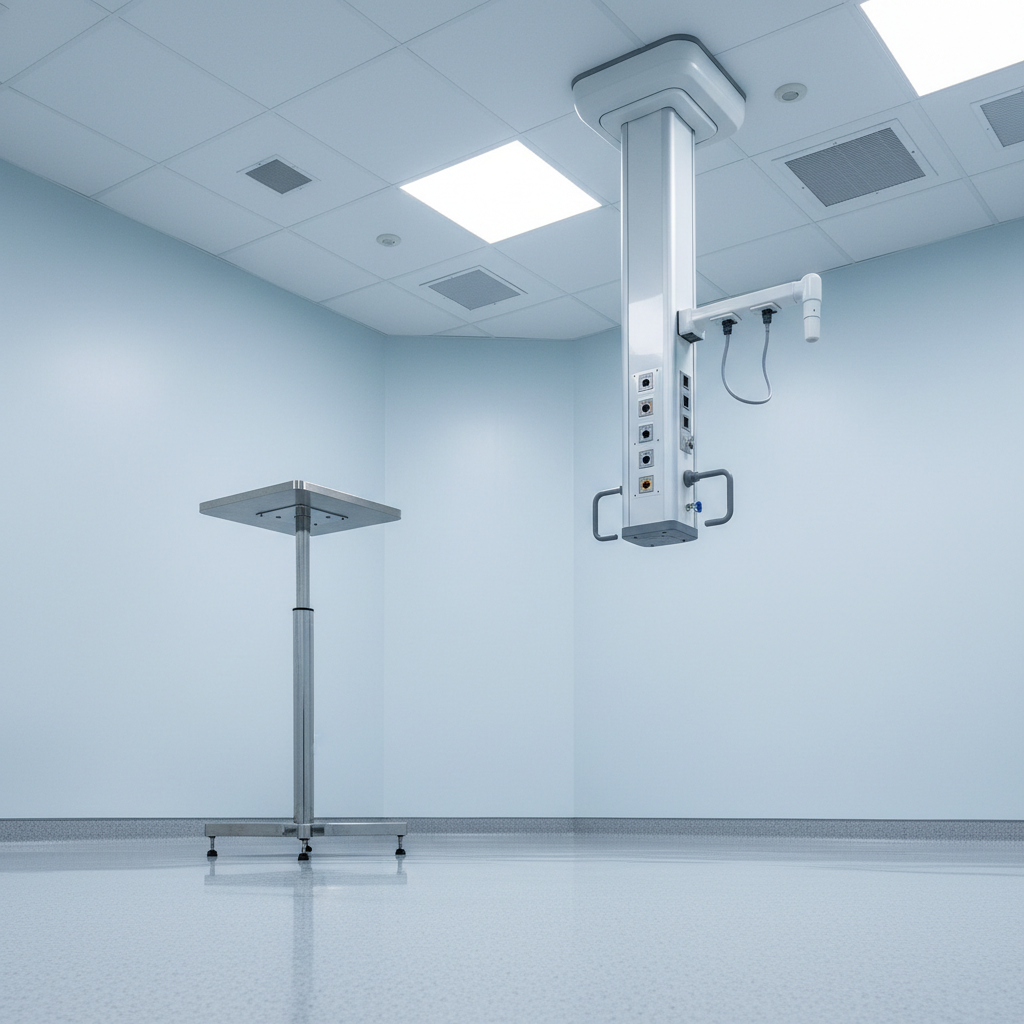
    • Ceiling Columns: These units are suspended from the ceiling. They come in two main varieties: fixed columns, which are stationary, and retractable columns, which can be raised or lowered to position services closer to the patient. MTS provides both retractable and fixed ceiling columns to suit various OR configurations.

    Both systems must be installed and verified by certified professionals to ensure they meet stringent safety standards. A certified ASSE 6010 installer must handle the physical installation, while an ASSE 6030 verifier must confirm the system is safe and functional before it can be used for patient care.

    Head-to-Head Comparison: Floor Pedestal vs. Ceiling Column

    Let's break down the comparison across several key criteria that are crucial for any healthcare facility when outfitting a new or renovated operating room.

    FeatureFloor PedestalFixed Ceiling ColumnRetractable Ceiling Column
    Footprint & SpaceOccupies fixed floor space; can be an obstruction.No floor footprint; fixed position from ceiling.No floor footprint; vertically adjustable.
    FlexibilityLow; fixed position limits room configuration.Moderate; services are off the floor but stationary.High; can be moved out of the way vertically.
    Infection ControlMore difficult to clean around the base; potential dirt trap.Easier to clean the floor underneath; smooth surfaces.Easiest to clean; can be retracted for full floor access.
    InstallationRequires floor penetration; coordination with sub-floor utilities.Requires significant ceiling structure support.Requires robust ceiling structure and lifting mechanism.
    Maintenance AccessGenerally straightforward access to service points.May require a ladder or lift for access.Requires a ladder/lift; maintenance of retraction mechanism.
    Best ForDental offices, smaller procedure rooms, ASCs.General surgery ORs, rooms with fixed table positions.Hybrid ORs, multi-purpose rooms, robotic surgery.

    Workflow and Ergonomics

    Ceiling columns are often favored in modern, high-acuity operating rooms for their superior ergonomics. By keeping hoses, cables, and connections off the floor, they significantly reduce tripping hazards, a major safety concern. A retractable column offers the ultimate flexibility, allowing staff to bring services close when needed and move them completely out of the way for procedures requiring more space or for cleaning. This is particularly valuable in hybrid ORs or rooms with mobile imaging equipment.

    Floor pedestals, while less flexible, provide a stable, predictable location for services. In environments like dental surgery or smaller ambulatory surgery centers (ASCs) where the room layout is fixed and less complex, a pedestal can be a cost-effective and reliable solution. However, the fixed nature means staff must work around the unit, and hoses will inevitably trail across the floor.

    Installation and Structural Considerations

    Neither system is a "plug-and-play" solution. Both require careful planning and professional installation.

    • Ceiling Columns: Installation is complex and requires robust structural support in the ceiling to handle the static and dynamic loads, especially for retractable or articulating boom systems. This often involves collaboration with structural engineers during the design phase. All installation work must be performed by a certified ASSE 6010 technician to comply with NFPA 99. After installation, a comprehensive medical gas verification by a credentialed ASSE 6030 verifier is mandatory.

    • Floor Pedestals: While avoiding overhead structural work, pedestals require penetrating the floor slab, which must be properly sealed to maintain the room's integrity and infection barrier. Coordination with plumbing and electrical trades running utilities under the slab is essential. Just like ceiling columns, the final system must be verified before use.

    Why this matters for compliance: NFPA 99 (Health Care Facilities Code), specifically Chapter 5, dictates the requirements for piped medical gas and vacuum systems. It mandates that systems be installed by qualified individuals (referenced by the ASSE 6000 series) and be thoroughly tested and verified to ensure patient safety. Failure to use certified professionals like the team at Medical Testing Solutions can result in project delays, failed inspections, and significant safety risks.

    Maintenance and Long-Term Reliability

    All medical gas delivery systems require regular upkeep to ensure they function safely and reliably. An annual inspection is the minimum requirement for maintaining compliance and safety.

    • Floor Pedestals: Being simpler mechanically, they often have fewer points of failure. Maintenance primarily involves inspecting outlets, checking pressures, and ensuring the unit's integrity. They are generally easier for technicians to access.

    • Ceiling Columns: Retractable columns have more moving parts (lifting mechanisms, brakes, cable management systems) that require periodic inspection and maintenance. Accessing the connections at the ceiling level requires appropriate equipment like ladders or lifts. Medical Testing Solutions offers comprehensive medical gas maintenance services to ensure these complex systems remain in peak condition.

    Cost Implications: Initial Outlay vs. Total Cost of Ownership

    Directly comparing costs is difficult without a specific project scope, but we can discuss general financial considerations.

    • Initial Cost: Floor pedestals typically have a lower initial equipment cost than ceiling columns. The installation can also be less expensive if significant overhead structural reinforcement is avoided.
    • Total Cost of Ownership (TCO): Ceiling columns, particularly retractable models, may offer a better TCO in the long run for busy, high-turnover operating rooms. The improved workflow, reduced trip-and-fall risk, and easier cleaning can translate to efficiency gains and lower incidental costs. The flexibility also future-proofs the room for new technologies and procedures, potentially delaying the need for more costly renovations down the line.

    When planning your budget, be sure to account for not just the equipment but also structural engineering, installation by an ASSE 6010 certified company, and the final ASSE 6030 verification. Request a quote from our team to get a detailed estimate for your specific project needs.

    Making the Right Choice for Your Facility

    The decision between a floor pedestal and a ceiling column comes down to a balance of space, function, budget, and future-planning.

    Choose a Floor Pedestal if:

    • You have a smaller procedure room or dental operatory.
    • The room layout is fixed and not expected to change.
    • Budget is the primary driver and floor space is adequate.
    • Your procedures are less complex with fewer required services.

    Choose a Ceiling Column if:

    • You are outfitting a high-acuity, multi-purpose operating room.
    • Minimizing floor clutter and trip hazards is a top priority.
    • The room will be used for procedures requiring flexible positioning of equipment (e.g., robotics, C-arms).
    • Ease of cleaning and superior infection control are critical goals.

    For many modern facilities, a hybrid approach using ceiling-mounted booms for the primary anesthesia and surgical sites, perhaps supplemented by a smaller pedestal or wall outlets for secondary needs, provides the greatest overall flexibility.

    Conclusion: Partner with Certified Experts for Your OR Build

    Whether you decide on a floor pedestal, a ceiling column, or a hybrid solution, the most important decision is choosing a qualified partner. The design, installation, and verification of medical gas delivery systems are highly regulated for a reason, patient safety is paramount.

    Medical Testing Solutions is an ASSE-certified company with deep expertise in medical gas infrastructure. We not only supply high-quality equipment like floor pedestals and ceiling columns but also provide the expert ASSE 6010 installation and ASSE 6030 verification services required for a compliant, turn-key solution.

    Don't leave your operating room's core infrastructure to chance. Contact our specialists today at (754) 315-1078 or request a quote online to discuss your project and ensure it's done right, from the start.


    Frequently Asked Questions

    Yes, when properly installed and verified. A floor pedestal is a compliant method for delivering medical gases and electrical power, provided it is installed by an ASSE 6010 certified technician and the entire system is verified by an ASSE 6030 verifier to meet NFPA 99 standards.

    All medical gas systems, including ceiling columns, require at least an annual inspection per NFPA 99. This involves checking for leaks, verifying pressures/flow, testing alarms, and inspecting the physical integrity of the column and its mounting. The maintenance plan should follow the manufacturer's recommendations.

    It depends. Both systems have a finite capacity. Adding services may be possible if the unit was originally specified with spare capacity. However, it often requires significant work, including recertification of the system. It's best to anticipate future needs during the initial design phase.

    The main advantage is flexibility. It allows the surgical team to position services exactly where they are needed, close to the patient, and then move them completely out of the way. This is ideal for cleaning, for procedures that require a large open space, or when bringing in mobile equipment.

    This article is provided for educational purposes and reflects industry standards as of publication. Always verify against current NFPA 99, CGA, and AHJ requirements. Medical Testing Solutions is ASSE-certified and ready to help — contact us for facility-specific guidance.

    Request a quote for your facility

    Talk with Medical Testing Solutions about your next inspection, repair or equipment request.

    Get a quote in 1 business day

    I agree to receive text messages from Medical Testing Solutions, L.L.C. at the phone number provided, including informational and marketing messages. Consent is not a condition of purchase. Message frequency varies. Message & data rates may apply. Reply STOP to opt out or HELP for help. See our Privacy Policy and Messaging Terms.

    Prefer to talk? Call (754) 315-1078

    Related articles