Skip to content
    New: Medical Gas Outlet Retrofit & Rebuild Matrix — cross-reference legacy Chemetron, Ohio Diamond, Puritan-Bennett & more →
    ASSE Certified 24/7
    Medical Gas Service
    Medical Gas Installation
    Compliance & Standards

    Dental Office Nitrous Oxide Installation in Raleigh, NC: A Complete Guide

    Medical Testing SolutionsSeptember 29, 20268 min read
    Share
    Dental Office Nitrous Oxide Installation in Raleigh, NC: A Complete Guide

    Designing Your Dental Nitrous Oxide System

    A compliant and efficient nitrous oxide/oxygen sedation system begins with a robust design. For a dental office in Raleigh, this phase is governed by the National Fire Protection Association (NFPA) 99 Health Care Facilities Code, specifically concerning Level 3 piped gas and vacuum systems. The design phase is not just about placing pipes; it's a comprehensive process that ensures safety, efficiency, and regulatory compliance from the ground up.

    Your system's architecture must account for the number of operatories, the anticipated usage rates, and the physical layout of your practice. A key decision is the location of the cylinder manifold or bulk supply. This "source equipment" must be in a dedicated, properly ventilated room with restricted access, constructed to meet specific fire-resistance ratings as outlined in NFPA 99.

    Key design considerations include:

    • Manifold Sizing: The central manifold must be sized to handle the peak demand of your practice without interruption. This involves choosing between automatic or manual changeover manifolds that switch from the primary to a secondary bank of cylinders as pressure drops.
    • Piping Layout: The piping network, typically medical-grade Type L or K copper, must be meticulously planned to provide the most direct and efficient routes from the source to the operatories. Pipe sizing is critical to maintain adequate pressure and flow to each station, especially in larger facilities.
    • Alarm Integration: Central and area alarm panels are mandatory. These systems monitor the gas pressure in the main lines and at specific zones, providing immediate audible and visual alerts for any high/low pressure variations, as specified by NFPA 99. This is a critical safety feature for any medical gas installation.
    • Scavenging System: An active waste anesthetic gas disposal (WAGD) system is not optional. The design must include a dedicated vacuum system, distinct from the dental suction system, to safely capture and exhaust exhaled nitrous oxide, protecting your staff from chronic exposure.

    Why this matters for compliance: A properly documented design is the first step reviewed during an inspection. NFPA 99 requires that plans for new Level 3 systems be reviewed and approved by the authority having jurisdiction (AHJ). Starting with a compliant design from a qualified firm like Medical Testing Solutions prevents costly rework and ensures patient safety.

    Core Components of a Dental N2O/O2 System

    Understanding the hardware involved is crucial for any practice owner. A typical turnkey system includes source equipment, a distribution network, and operatory-specific components.

    Source Equipment: Manifolds and Cylinders

    This is the heart of your gas supply.

    • Nitrous Oxide & Oxygen Manifolds: These are assemblies that connect multiple high-pressure cylinders to the main pipeline. An automatic changeover manifold is the standard of care, ensuring an uninterrupted gas supply by automatically switching to the reserve bank when the primary bank is depleted. It sends a signal to the alarm panel, alerting staff to replace the empty cylinders.
    • High-Pressure Cylinders: These are the familiar "tanks" of N2O and O2. They must be stored securely in the designated source room, chained or bracketed to prevent tipping.
    • Pressure Regulators: Primary and secondary regulators step down the high pressure from the cylinders to a safe, usable line pressure (typically 50-55 psi for both N2O and O2).

    Distribution: Piping, Valves, and Alarms

    This network safely delivers the gases to the point of use.

    • Medical-Grade Copper Piping: NFPA 99 mandates the use of specific, cleaned, and capped copper tubing (ASTM B819) to prevent contamination of the medical gases.
    • Zone Valve Boxes: These are installed in accessible locations to isolate specific "zones" or groups of operatories in an emergency or for maintenance without shutting down the entire facility.
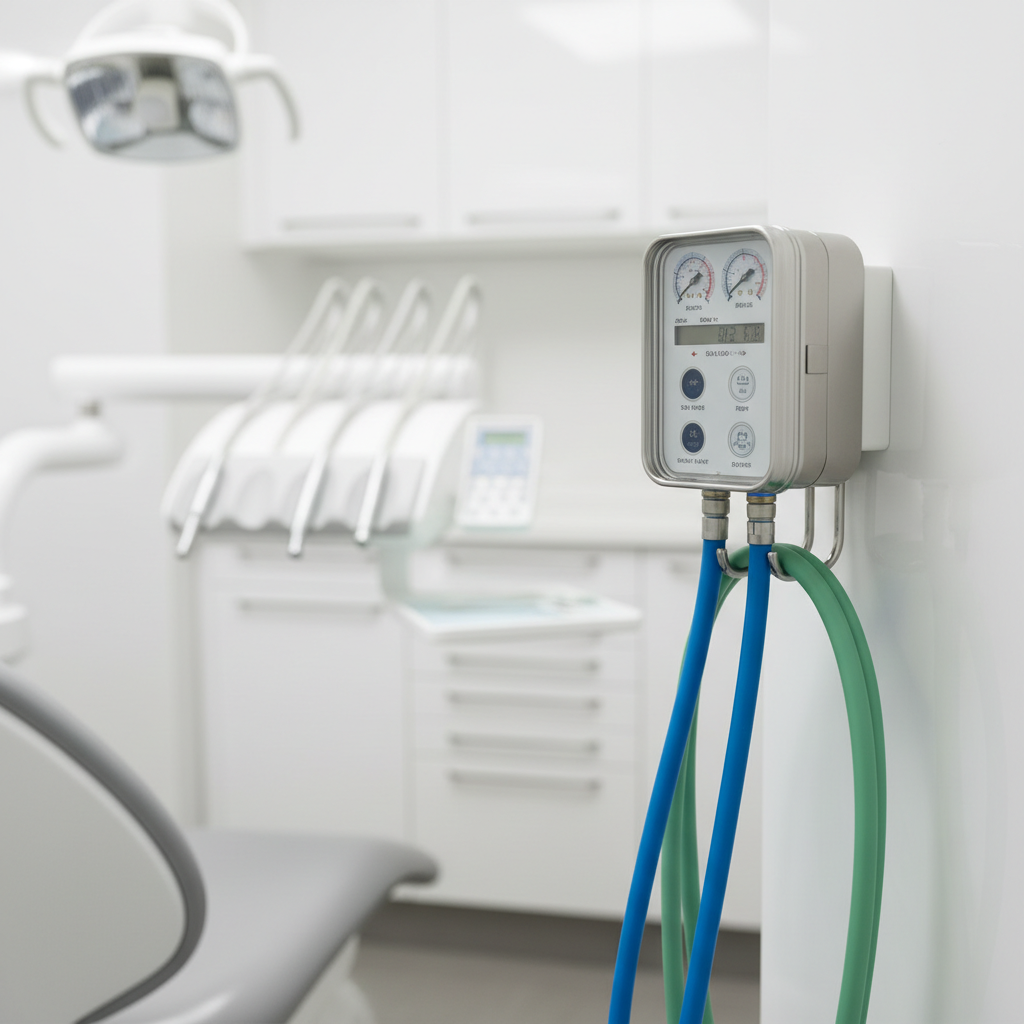
    • Alarm Panels: Master alarms are located where they can be continuously monitored (e.g., reception or a staff lounge), while area alarms are placed in the specific zones they serve. They provide immediate warnings of pressure fluctuations that could indicate a leak or supply issue.

    Operatory Components: Flowmeters and Scavengers

    These are the patient-facing components.

    • Sedation Flowmeters: Devices like the Porter MXR or Belmed PC7 are precision instruments that mix N2O and O2 and deliver it to the patient. They have critical safety features, such as a minimum 30% oxygen flow and a failsafe that shuts off N2O if the oxygen supply is lost. Regular service, including dental flowmeter repair and calibration, is essential for accuracy and patient safety.
    • Nasal Hoods and Scavenging Masks: These are the single-use or sterilizable masks that deliver the gas mixture. The outer mask and vacuum connection are part of the WAGD system, actively pulling away exhaled gas.

    The Installation Process: An ASSE 6010 Certified Approach

    Installation of a medical gas system is not a standard plumbing job. It must be performed by individuals certified to the ASSE 6010 Medical Gas Systems Installer standard. This certification ensures the installer has the expertise to work with medical-grade materials and understands the stringent requirements of NFPA 99.

    Here is a typical step-by-step process:

    1. Pre-Installation Review: The certified installers from a company like Medical Testing Solutions will review the approved design plans and coordinate with other trades (electricians, general contractors) on-site in your Raleigh office.
    2. Piping Installation: All piping is installed using a brazing process with a continuous nitrogen purge. This "purge" prevents the formation of carbonaceous deposits (soot) inside the pipes, which could otherwise be blown into the patient's lungs.
    3. Component Mounting: Source manifolds, alarm panels, and zone valve boxes are securely mounted according to the plans.
    4. Initial Pressure Test: Once the piping is complete, it is charged with high-pressure, oil-free nitrogen to check for leaks at the brazed joints.
    5. Cross-Connection Test: This critical step ensures that the N2O and O2 pipes were not accidentally connected to the wrong source. The system is tested to confirm that gas flows only from the correctly labeled outlets.
    6. Labeling: All pipes, valves, and outlets are clearly and permanently labeled with the name of the gas they carry, per NFPA 99 requirements.

    Scavenging and WAGD: Protecting Your Staff

    Waste Anesthetic Gas Disposal (WAGD) is a primary safety concern for dental staff. Chronic exposure to low levels of nitrous oxide has been linked to various health issues. OSHA and NIOSH have set recommended exposure limits (RELs) for N2O.

    A properly installed and maintained scavenging system is your primary defense. This system must be sized and balanced to provide the recommended vacuum flow rate at each nasal hood (typically around 45 L/min). It's essential that the WAGD system is regularly tested and that your office implements a WAG chemical vapor monitoring program to ensure it remains effective.

    ComponentFunctionNFPA 99/OSHA Consideration
    WAGD ProducerThe vacuum pump creating the negative pressure.Must be vented to the exterior, away from fresh air intakes.
    Nasal HoodCaptures exhaled N2O at the source (the patient).Good mask fit is critical for capture efficiency.
    Flow ControlVisual indicator (often a floating ball) on the flowmeter.Must be adjusted to the manufacturer's recommended level (e.g., in the green zone).
    TubingConnects the mask to the vacuum outlet.Must be free of kinks and obstructions.

    Post-Installation Verification: The ASSE 6030 Standard

    After the ASSE 6010 installer completes their work, the system CANNOT be used until it is independently verified. This verification must be performed by a different individual, certified to the ASSE 6030 Medical Gas Verifier standard.

    This crucial final step ensures the system is safe for patient use. The verifier is a third-party inspector who works for the facility owner, not the installer. Medical Testing Solutions provides this essential medical gas verification service to dental practices throughout Raleigh and the surrounding areas.

    The ASSE 6030 verification process includes:

    • Final Pressure & Leak Tests: Confirming the system holds pressure with no leaks.
    • Cross-Connection Verification: A second, more rigorous check to ensure gases are not mixed up.
    • Purity & Particulate Tests: Sampling the gas at each outlet to confirm it is the correct gas (e.g., 99.0% N2O) and free from contaminants.
    • Alarm System Testing: Activating every alarm condition (high/low pressure, changeover) to ensure the panels function correctly.
    • Labeling and Component Checks: Verifying that all components are correctly installed and labeled per NFPA 99.

    Only after the verifier signs off and provides a detailed report can the system be legally and safely placed into service.

    Maintaining Your System for Long-Term Compliance

    Your responsibility doesn't end after verification. NFPA 99 mandates ongoing maintenance and inspections to ensure the system remains compliant and safe over its lifetime. This includes:

    • Daily Checks: Staff should check cylinder pressures and manifold status.
    • Annual Inspections: A comprehensive check of the entire system, from source to outlets, should be performed by a qualified professional. This is a core service provided by MTS. Learn more about our annual medical gas inspections.
    • Regular Flowmeter Calibration: Ensure your flowmeters are delivering the correct gas concentrations.
    • Record Keeping: Maintain a log of all inspections, maintenance, and repairs.

    Get a Quote for Your Raleigh Dental Office

    A compliant, professionally installed nitrous oxide and oxygen delivery system is a significant asset to a modern dental practice, enabling a higher level of patient care and comfort. But installation is a complex process with zero margin for error.

    At Medical Testing Solutions, our ASSE-certified team has decades of experience designing, installing, and verifying dental gas systems across North Carolina. We provide turnkey solutions that guarantee safety and compliance from day one.

    Ready to get started? Contact our team today for a comprehensive quote for your Raleigh practice. Call us at (754) 315-1078 or request a quote online to ensure your project is done right.


    Frequently Asked Questions

    For a typical dental office, the installation process can take anywhere from 2 to 5 days, depending on the size of the practice and the complexity of the piping runs. This does not include the final ASSE 6030 verification, which usually takes another day.

    No. NFPA 99 requires that medical gas and vacuum systems be installed by individuals certified to the ASSE 6010 standard. This ensures they have the specialized training for brazing, purging, and understanding the code requirements.

    The installer physically builds the system. The verifier is an independent, third-party inspector who tests and certifies that the installer's work meets all NFPA 99 code requirements. The same person or company cannot perform both roles on the same project to avoid a conflict of interest.

    A full, ASSE 6030-compliant verification is required upon initial installation or if any modifications are made to the system. Following that, NFPA 99 mandates annual inspections by a qualified technician to ensure ongoing safety and functionality.

    The primary standard is the NFPA 99 Health Care Facilities Code. Additionally, the ASSE 6000 series (6010 for Installers, 6030 for Verifiers) provides the personnel certification standards. The Compressed Gas Association (CGA) also publishes relevant guidelines for gas handling and safety.

    This article is provided for educational purposes and reflects industry standards as of publication. Always verify against current NFPA 99, CGA, and AHJ requirements. Medical Testing Solutions is ASSE-certified and ready to help — contact us for facility-specific guidance.

    Request a quote for your facility

    Talk with Medical Testing Solutions about your next inspection, repair or equipment request.

    Get a quote in 1 business day

    I agree to receive text messages from Medical Testing Solutions, L.L.C. at the phone number provided, including informational and marketing messages. Consent is not a condition of purchase. Message frequency varies. Message & data rates may apply. Reply STOP to opt out or HELP for help. See our Privacy Policy and Messaging Terms.

    Prefer to talk? Call (754) 315-1078

    Related articles