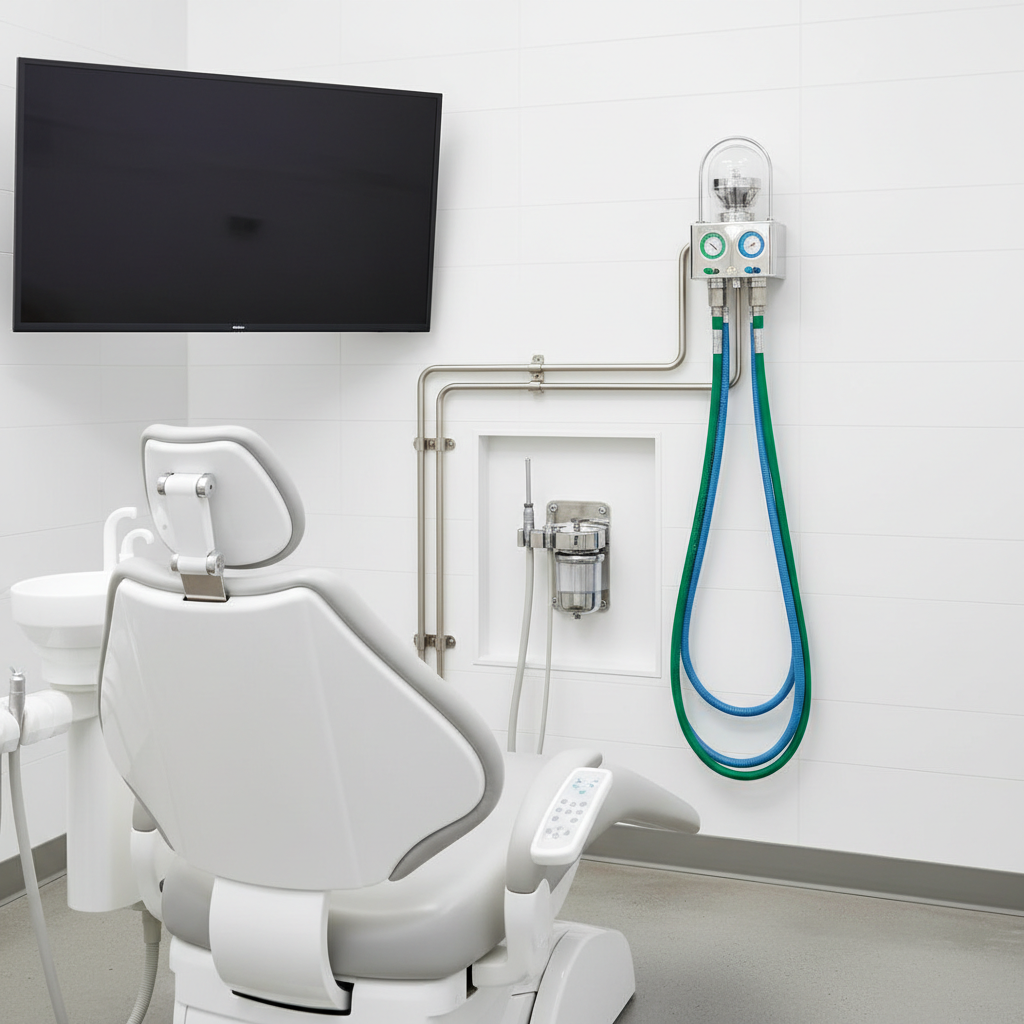
Turnkey Dental Nitrous Oxide & Oxygen Systems in Asheville
Installing a nitrous oxide and oxygen sedation system in a dental office is more than just connecting pipes and tanks; it's a critical infrastructure project governed by strict safety codes to protect patients and staff. For dental practices in Asheville, NC, a properly designed and installed system is essential for offering safe and effective minimal sedation. This guide walks you through the entire turnkey process, from initial design and equipment selection to the final verification and certification, ensuring your installation is compliant, safe, and efficient from day one.
You will learn the key components of a dental gas system, the importance of integrated scavenging, the role of alarm systems, and the critical steps for post-installation verification as required by the National Fire Protection Association (NFPA) and the American Society of Sanitary Engineering (ASSE).
Understanding the Core Components of a Dental Gas System
A compliant dental nitrous oxide/oxygen system is comprised of three main parts: the source equipment (manifolds), the pipeline distribution system, and the terminal equipment (flowmeters and scavenging masks). Each component must meet specific standards to ensure safety and reliability.
Source Equipment: Manifolds and Cylinders
- Nitrous Oxide (N2O) Manifold: This is the heart of your system. For most dental offices, an automatic changeover manifold is the standard. It connects to multiple N2O cylinders (typically G or H size) and automatically switches from the primary bank to the secondary bank when pressure drops, ensuring an uninterrupted gas supply. This prevents the disruption of a procedure mid-session.
- Oxygen (O2) Manifold: Similar to the N2O manifold, this system manages your oxygen supply. Oxygen is not just for sedation mixing; it's a critical safety component used to flush the system and provide 100% O2 to the patient if needed.
- Cylinder Storage: NFPA 99 (Chapter 5) has strict requirements for the storage of medical gas cylinders. They must be stored in a dedicated, well-ventilated room, away from flammable materials, and properly secured with chains or straps to prevent tipping.
Pipeline Distribution
- Piping: All medical gas piping must be Type K or L seamless copper, cleaned for oxygen service, and clearly labeled. The pipes carry the N2O and O2 from the manifold room to the individual operatories.
- Zone Valves: Each operatory or group of operatories must have a zone valve box. This allows staff to shut off the gas supply to a specific area in an emergency without affecting the rest of the facility. These are a crucial safety feature.
Terminal Equipment & Scavenging
- Outlets: Each operatory will have quick-connect outlets for both N2O and O2. These outlets are gas-specific (e.g., a DISS connection) to prevent accidental cross-connection.
- Flowmeters: Devices like the Porter MXR-D or Belmed PC7 are mounted in the operatory. They blend the N2O and O2 and deliver the precise mixture to the patient. Regular calibration of these units is essential for patient safety. For more on this, see our guide to dental flowmeter repair and calibration.
- Scavenging System: This is arguably one of the most critical safety components for staff. A scavenging system, integrated with your high-volume evacuation (HVE) system, removes exhaled nitrous oxide from the room, preventing chronic exposure for dentists and assistants. OSHA has exposure limits for N2O, making effective scavenging a non-negotiable part of the system.
Why this matters for compliance: NFPA 99, Chapter 5.1.3.4, outlines the requirements for medical gas and vacuum systems. A system that doesn't meet these stringent standards for materials, installation, and testing is not only a safety hazard but will fail its final verification, delaying your ability to use the system and potentially impacting your practice's certificate of occupancy.
The Installation Process: An ASSE 6010 Certified Approach
A successful installation hinges on meticulous planning and execution by certified professionals. Medical Testing Solutions employs ASSE 6010 Certified Installers to ensure every step adheres to code.
- Design & Layout: We work with your architect and builder to plan the manifold room location, pipeline routing, and terminal placement in each operatory.
- Brazing & Purging: During installation, every joint in the copper pipeline is brazed (not soldered). While brazing, a continuous flow of nitrogen is passed through the pipes. This "nitrogen purge" displaces oxygen, preventing the formation of copper oxides on the interior surface of the pipe, which could otherwise flake off and contaminate the gas stream.
- Labeling: All piping is meticulously labeled with the gas name and direction of flow at specific intervals, as required by code.
- Alarm Integration: Master and area alarm panels are installed and connected to the source equipment and pipeline pressure sensors. These alarms provide immediate audible and visual warnings of system malfunctions.
Comparing Key System Components & Standards
| Component | NFPA 99 Requirement | Common Brands | Key Consideration |
|---|---|---|---|
| Manifold | Automatic changeover (5.1.3.5.8) | Tri-Tech Medical, Amico, Ohio Medical | Must provide uninterrupted supply and trigger a low-pressure alarm. |
| Piping | ASTM B819 Seamless Copper (Type K/L) | Must be cleaned for oxygen service. | |
| Alarms | Master/Area Alarms (5.1.9) | Tri-Tech Medical, Amico | Must monitor gas pressure and vacuum levels, providing immediate alerts. |
| Flowmeter | Must have O2 fail-safe and min. 30% O2 flow | Porter, Belmed, Accutron, Matrx | Fail-safe prevents 100% N2O delivery. Regular calibration is critical. |
| Scavenging | Required to limit personnel exposure | Integrated w/ HVE system | Must effectively capture waste anesthetic gas (WAG) at the source. |