Skip to content
    New: Medical Gas Outlet Retrofit & Rebuild Matrix — cross-reference legacy Chemetron, Ohio Diamond, Puritan-Bennett & more →
    ASSE Certified 24/7
    Medical Gas Service
    Compliance & Standards

    Dental Flowmeter Repair Minneapolis MN: $750 Flat-Rate Service

    Medical Testing SolutionsOctober 29, 202614 min read
    Share
    Dental Flowmeter Repair Minneapolis MN: $750 Flat-Rate Service

    Dental Flowmeter Repair Minneapolis MN: Factory-Grade Service

    Nitrous oxide conscious sedation remains one of the safest and most reliable tools for patient comfort across Twin Cities dental practices. However, maintaining the precision of your sedation delivery system requires strict technical adherence to clinical standards and life-safety codes. When an operatory flowmeter begins sticking, hissing, or failing internal leak checks, dental clinics across Hennepin and Ramsey counties need a rapid, compliant solution that avoids astronomical replacement costs.

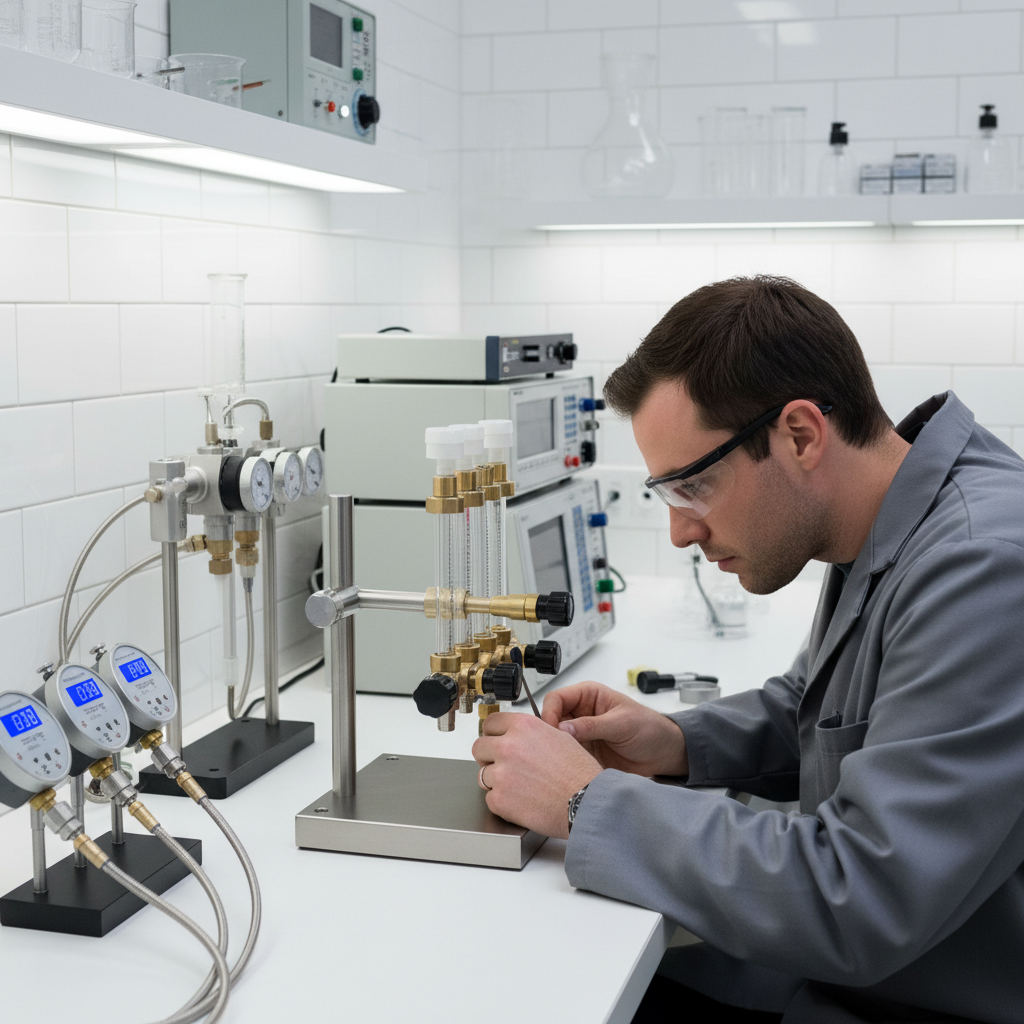
    Medical Testing Solutions provides specialized dental flowmeter repair for Minneapolis, MN clinics through an expedited, flat-rate $750 mail-in restoration program. Whether your practice operates analog glass-tube mixing heads or digital sedation consoles from Porter, Belmed, Accutron, or Matrx by Midmark, our factory-trained technicians rebuild, calibrate, and pressure-test your units to meet original manufacturer specifications and NFPA 99 healthcare facility requirements. In this comprehensive guide, you will learn how our flat-rate program works, the mechanical points of failure that threaten clinical safety, and how to stay fully compliant with Minnesota Board of Dentistry rules.


    The Critical Role of Nitrous Oxide Flowmeters in Dental Sedation

    A dental nitrous oxide delivery unit is a precision mixing instrument. Unlike industrial flow devices, a dental sedation flowmeter regulates life-supporting oxygen alongside nitrous oxide under tight physiological boundaries. Modern dental flowmeters incorporate a mechanical or electronic safety interlock designed to guarantee a minimum oxygen concentration, mandated across the industry at no less than 30% oxygen delivery (and a maximum of 70% nitrous oxide). | Diagram text | |, | When internal proportioning diaphragms warp, O-rings degrade, or needle valves accumulate debris, the gas ratio drifting out of tolerance creates severe clinical liabilities:

    1. Hypoxic Risk: If the mechanical interlock fails or internal proportioning slips, a patient can inadvertently receive a hypoxic gas mixture containing less than atmospheric oxygen concentrations (21% O2).
    2. Sub-Therapeutic Sedation: Under-delivering nitrous oxide results in patient anxiety, aborted procedures, and clinic schedule delays.
    3. Occupational Gas Exposure: Leaking flowmeter seals discharge ambient N2O directly into the clinician's breathing zone, elevating clinic levels past NIOSH recommended exposure limits (25 ppm TWA).

    For dental practices in Minneapolis, St. Paul, Bloomington, and surrounding suburbs, flowmeter maintenance is a foundational patient safety standard.


    Why Minneapolis Dental Clinics Choose Our $750 Flat-Rate Mail-In Program

    Local biomedical service providers in the Upper Midwest often charge by the hour, bill separately for replacement component kits, and add travel fees simply to walk through your clinic doors. In many cases, non-specialized service techs end up sending your unit out to third-party depots anyway, adding margin markups and extending turnaround times.

    Medical Testing Solutions streamlines this process through our dedicated dental flowmeter repair and calibration services. For a predictable, flat rate of $750, Minneapolis clinicians receive a complete factory rebuild:

    • No Hidden Diagnostic Fees: Whether your flowmeter has a cracked sight tube, blown diaphragm, or failed O2 flush valve, the base repair and overhaul are covered under one fixed price.
    • Rapid Depot Turnaround: Once received at our specialized laboratory, units are typically rebuilt, calibrated, and cleared for return within 48 to 72 hours, minimizing your operatory downtime.
    • Full Traceable Documentation: Every serviced flowmeter returns with a certified calibration certificate referencing NIST-traceable testing apparatus, fulfilling Minnesota Department of Health and dental board audit trails.
    • Nationwide Logistical Efficiency: Shipping your head unit from Minneapolis via tracked courier (FedEx or UPS) gets your device onto our master test benches fast, fully insured, and serviced by ASSE-credentialed gas specialists.

    Supported Flowmeter Brands: Porter, Belmed, Accutron, and Matrx

    Dental sedation equipment varies significantly in design, from pneumatic glass-tube flow indicators to microprocessor-driven digital displays. Medical Testing Solutions maintains extensive factory-grade parts inventory for all primary dental sedation brands operating in Minnesota dental operatories.

    Manufacturer / PlatformCommon ModelsFlow TypePrimary Service Items Addressed
    Porter InstrumentMXR-1, MXR-3000, 3400 Series, Digital MDAnalog & DigitalProportioning control rebuild, glass tube replacement, 30% O2 interlock realignment
    AccutronUltra PC%, Digital Ultra, Newport FlowmeterAnalog & DigitalDual-reservoir seal packs, fail-safe cutoff diaphragm replacement, keypad diagnostics
    BelmedPC-7, 509 Universal, Flow-Maker SystemAnalog GlassNeedle valve rebuild, O-ring renewal, internal manifold leak testing, bag tee re-seating
    Matrx by MidmarkDigital MDT, Matrx Analog, MD-1000Analog & DigitalSolenoid valve packs, digital sensor recalibration, emergency O2 flush rebuilding

    Porter Instrument MXR Rebuilds

    The Porter MXR is widely regarded as the historical workhorse of conscious sedation. Built with dual-flowmeter glass tubes and a central proportioning knob, it delivers fine gas mixing. Our technicians disassemble the primary proportioner, replace the internal Teflon and Viton packing glands, set mechanical stops to ensure a minimum 30% oxygen floor, and rebuild the emergency oxygen flush valve.

    Accutron Digital and Analog Lines

    Accutron's Digital Ultra and Ultra PC% units require precise pressure calibration. Digital units undergo sensor diagnostics, solenoid cycling tests, and microprocessor flow cross-checks against precision digital mass flow meters. For analog models, we replace the dual-glass float chambers, clear static drag, and test the audible/pneumatic loss-of-oxygen alarms.

    Belmed Precision Devices

    Belmed flowmeters rely on compact, robust manifold blocks. Over time, internal lubrication hardens and microscopic particulate scores the needle valves. We acid-clean the brass blocks, replace all elastomeric seals, install factory O-rings, and verify that the 30 psig low-pressure fail-safe cutoff isolates nitrous oxide delivery instantly.

    Matrx / Midmark Sedation Units

    Matrx analog and digital systems frequently experience bypass leakage around the emergency oxygen flush switch and the 22mm mixed gas outlet. Our rebuild service resets the diaphragm seating, restores the oxygen flush output to the factory-mandated 30–50 L/min threshold, and clears pressure tracking errors on digital displays.


    Common Signs Your Nitrous Oxide Flowmeter Requires Immediate Rebuilding

    Flowmeter degradation rarely happens overnight; subtle mechanical shifts develop over months of clinical cycling. Minneapolis practice managers and clinical assistants should monitor for the following warning signs:

    1. Drift in the Mixed Gas Percentage

    If setting the dial to 50% N2O and 50% O2 produces uneven float balls (for example, the oxygen ball drops to 3 L/min while nitrous floats at 5 L/min), internal proportioning has slipped out of factory calibration.

    2. Sticking or Erratic Float Balls

    Analog glass tubes can accumulate moisture, oil residues from aging practice compressors, or electrostatic charges. If the float ball sticks to the bottom or top of the tube, or fails to drop smoothly when gas is shut off, the metering tube assembly requires bench cleaning or replacement.

    3. Continuous Hissing When Connected to Outlets

    A subtle hiss behind the operatory wall or from the flowmeter housing indicates degraded DISS (Diameter Index Safety System) fittings, worn inlet check valves, or ruptured internal bypass seals.

    Why this matters for compliance

    Under NFPA 99 (Health Care Facilities Code), 2024 Edition, Section 15.5.3.2, waste anesthetic gases must not migrate into unventilated clinic environments. Escaping nitrous oxide from deteriorated flowmeter seals breaches occupational safety limits and violates the practice's duty of care.

    4. Failed Oxygen Fail-Safe Activation

    When the primary oxygen line drops below 30 psig (which you can test by depressing the O2 flush with the wall hose disconnected), the nitrous oxide delivery must shut off completely. If nitrous continues to flow when oxygen supply drops, the unit presents an acute patient safety risk and must be removed from service immediately.

    5. Sticky or Inoperative Oxygen Flush Button

    The emergency O2 flush must instantly deliver an unmetered rush of 100% oxygen (between 30 and 50 L/min) to purge the patient circuit in an emergency. If this button resists travel, fails to return, or produces a weak stream, the internal poppet valve is failing.


    The Medical Testing Solutions Factory-Grade Rebuild Process

    Our $750 flat-rate service is not a cosmetic wipe-down or external leak check. We subject your flowmeter to a comprehensive bench overhaul conducted by gas specialists certified to ASSE standards. | Diagram text | |, | | Phase 1: Receiving Inspection & Dynamic Baselines | | - Incoming pressure integrity scan | | - Pre-service flow rate & ratio documentation | | Phase 2: Complete Disassembly & Chemical Clean | | - Separation down to bare brass manifold | | - Ultrasonic cleaning of non-elastomeric parts | | Phase 3: Component Replacement & Re-Assembly | | - All-new medical-grade Viton/PTFE O-rings & seals | | - New internal filter screens & proportioning diaphragms | | Phase 4: NIST-Traceable Calibration & Bench Testing | | - 30% Minimum O2 mechanical interlock calibration | | - 30-50 L/min Emergency O2 flush verification | | - 24-hr static pressure holding & fail-safe testing | | Phase 5: Certification & Return Shipping | | - Issuance of formal calibration certificate | | - Custom double-boxed protective dispatch to MN |

    Detailed Breakdown of Rebuild Stages:

    1. Intake and Triage: The flowmeter is inspected for physical chassis damage, stripped threads, and cracked glass tubes. We log baseline performance to pinpoint underlying operational failures.
    2. Ultrasonic Decontamination: Manifold blocks are treated in medical-grade ultrasonic baths to strip out micro-particulate, dried lubricants, and corrosion without eroding precision internal tolerances.
    3. Pneumatic Seal Replacement: Every internal elastomeric seal, gasket, filter screen, and packing gland is discarded and replaced with factory-spec, medical-gas-compatible components. We ensure that all lubricants used are strictly oxygen-safe (Krytox/Fluorolube) to eliminate combustion hazards.
    4. Calibration to NIST Standards: Using calibrated digital mass flow meters, our technicians adjust the flowmeter across multiple points (e.g., 10%, 30%, 50%, 70% N2O delivery). We lock in the mechanical stop preventing oxygen from being dialed below 30%.
    5. Static and Dynamic Pressure Testing: The flowmeter is pressurized to 55 psig on both lines and monitored for pressure decay over 24 hours. The oxygen fail-safe mechanism is verified under induced pressure drop conditions.
    6. Final Documentation: A serial-numbered Certificate of Calibration is generated, detailing pre- and post-calibration metrics, test apparatus calibration dates, and technician signatures.

    Codes and Regulatory Standards Governing Dental Sedation in Minnesota

    Operating a dental sedation practice in Minneapolis requires compliance with a matrix of federal, state, and local life-safety codes. Overlooking regular flowmeter recertification can lead to disciplinary findings during health inspections.

    Minnesota Board of Dentistry Rules

    Minnesota Administrative Rules Chapter 3100 mandates that any dental clinic utilizing nitrous oxide inhalation sedation maintain equipment that is clean, calibrated, and properly scavenged. Practitioners must verify that their delivery devices are mechanically restricted from delivering hypoxic mixtures and that scavenging devices operate efficiently to prevent staff exposure.

    NFPA 99: Health Care Facilities Code

    NFPA 99 categorizes dental nitrous oxide and oxygen delivery under Category 3 or Category 2 medical piping systems (depending on whether deep sedation or general anesthesia is administered).

    • NFPA 99 Section 5.1.14.2 / 15.5: Outlines requirements for regular maintenance and inspection of terminal delivery equipment.
    • Flowmeters must connect using gas-specific DISS connections to prevent gas cross-connection hazards.
    • All emergency shutoffs and pressure safety valves must function under defined parameters.

    ASSE 6000 Professional Qualifications

    Medical Testing Solutions provides ASSE-certified technicians across multiple disciplines:

    CGA (Compressed Gas Association) Standards

    The Compressed Gas Association publishes Pamphlet G-4.1 (Cleaning Equipment for Oxygen Service) and Pamphlet V-1 (Compressed Gas Cylinder Valve Outlet and Inlet Connections). When servicing your flowmeter, we enforce strict compliance with CGA oxygen-cleaning protocols, ensuring that zero hydrocarbons exist within the gas pathway that could trigger an adiabatic compression ignition.


    Upstream Pipeline Integrity: Don’t Overlook the Source

    Even a freshly calibrated Porter or Accutron flowmeter cannot deliver correct gas mixtures if the central pipeline feeding your operatory is compromised. If your clinic's central oxygen regulator is drifting to 38 psig while the nitrous line sits at 55 psig, the flowmeter's internal differential balance will struggle to compensate. | Diagram text | |, | To ensure comprehensive safety, dental practices should coordinate depot flowmeter repair with site-level verification:


    Step-by-Step: How Minneapolis Practices Ship Flowmeters for Flat-Rate Service

    Sending your flowmeter to Medical Testing Solutions is straightforward. Follow these clinical shutdown and packing steps to protect sensitive metering valves during transit:

    1. Isolate and Depressurize the System

    Shut off the local zone valves or operatory shut-off valves for both oxygen and nitrous oxide. Depress the emergency oxygen flush button and open both flow valves until line pressures register zero on all station gauges.

    2. Disconnect Gas Supply Lines

    Uncouple the high-pressure DISS or quick-connect hoses from the back or bottom of the flowmeter head. Remove the scavenger hose and reservoir bag tee.

    3. Detach the Flowmeter from Mountings

    Carefully unbolt the unit from its wall mount, mobile cart, or cabinet slide arm. Retain mounting screws and lock washers at your clinic. Do not ship mounting arms or heavy wall brackets, as this unnecessarily increases shipping weights.

    4. Pack with Ample Cushioning

    Wrap the flowmeter head completely in at least three layers of heavy-duty bubble wrap. Glass-tube flowmeters (like the Porter MXR or Belmed PC-7) must be protected from shock loads. Place the wrapped head inside a sturdy cardboard box, ensuring at least two inches of space around all sides filled with dense packing peanuts or void fill.

    5. Enclose Documentation and Dispatch

    Include your clinic name, Minneapolis contact person, operatory number, email address, and a brief note describing any known symptoms (e.g., "Nitrous float sticking at 2 L/min"). Ship via FedEx or UPS directly to Medical Testing Solutions' service depot.


    Cost Comparison: Mail-In Flat-Rate Repair vs. Local Service vs. Unit Replacement

    Investing in dental operatory equipment requires balancing equipment longevity against operational budget constraints. Replacing a functional flowmeter with a new unit often costs thousands of dollars when installation is factored in.

    MetricMTS Flat-Rate Mail-In ProgramLocal Biomedical Field ServiceNew Flowmeter Replacement
    Total Estimated Cost$750 flat rate$1,100 – $1,600+ (Parts + Travel + Hourly)$3,800 – $6,500+ per operatory
    Turnaround Time48–72 hours at depot + transit2–4 weeks (pending technician dispatch)Immediate to 6 weeks (backorder dependent)
    Calibration TraceabilityNIST-traceable certificate includedOften limited to field sniffer checksFactory certificate included
    Parts Replaced100% of wear parts, seals, diaphragmsOnly immediate failing componentNew unit complete
    ASSE 6000 OversightYes (Certified Master Gas Technicians)Rare (General biomedical techs)N/A (Manufacturer warranty)
    Warranty ProtectionComprehensive Service Warranty30-day limited warranty on field work1-year manufacturer warranty

    By choosing our $750 flat-rate rebuild, Minneapolis practices save thousands of dollars per operatory while restoring their clinical equipment to factory-fresh performance standards.


    Maintain Total Sedation Safety with Medical Testing Solutions

    A failing nitrous oxide flowmeter compromises patient safety, staff health, and regulatory standing. Rather than paying unpredictable local service rates or spending thousands on unneeded unit replacements, Minneapolis dental practices rely on the speed, transparency, and clinical excellence of Medical Testing Solutions.

    Whether your clinic operates in Downtown Minneapolis, Uptown, Edina, Plymouth, or Minnetonka, our ASSE-certified team is equipped to handle all your medical gas equipment needs, from flowmeter rebuilding to full facility ASSE 6030 verification and safety audits.

    To schedule your $750 flat-rate dental flowmeter repair or to speak directly with an ASSE-certified medical gas specialist, contact Medical Testing Solutions today:


    Frequently Asked Questions

    Transit time from the Minneapolis-St. Paul metro area via standard ground is typically 3 business days, or overnight via express air. Once received at our depot, our technicians rebuild and calibrate the unit within 48 to 72 hours. Your clinic can expect your flowmeter back within 7 to 9 business days total, or under 4 business days if expedited shipping is selected.

    Our $750 flat rate includes complete disassembly, ultrasonic cleaning of internal manifolds, replacement of all wearable elastomeric seals, O-rings, and diaphragm packs, replacement of standard needle valves, calibration of the 30% minimum oxygen safety stop, dynamic flow testing, emergency oxygen flush rebuilding, and a formal NIST-traceable calibration certificate.

    Per manufacturer guidelines, ADA recommendations, and NFPA 99 maintenance protocols, dental nitrous oxide flowmeters should undergo functional testing annually and receive a complete depot rebuild and factory calibration every 2 to 3 years. Any float ball sticking or gas hissing warrants immediate servicing.

    No. An external gas analyzer can measure gas percentage at the mask, but it cannot recalibrate internal mechanical proportioners, rebuild worn diaphragm seatings, or test internal static pressure decay. Proper recalibration requires certified clean-gas test benches and specialized tooling to adjust internal interlocks safely.

    Yes. We maintain replacement parts and inventory for numerous legacy flowmeters, including older Matrx MD-1000 units, legacy Accutron Newport systems, and classic Porter MXR analog consoles. Contact our team with your unit's serial and model number for verification.

    Yes. Every unit rebuilt by Medical Testing Solutions is returned with an individualized Certificate of Calibration listing your flowmeter’s serial number, measured flow tolerances, fail-safe trip pressures, and calibration dates of the NIST-traceable test equipment used, satisfying Minnesota Board of Dentistry requirements.

    This article is provided for educational purposes and reflects industry standards as of publication. Always verify against current NFPA 99, CGA, and AHJ requirements. Medical Testing Solutions is ASSE-certified and ready to help — contact us for facility-specific guidance.

    Request a quote for your facility

    Talk with Medical Testing Solutions about your next inspection, repair or equipment request.

    Get a quote in 1 business day

    I agree to receive text messages from Medical Testing Solutions, L.L.C. at the phone number provided, including informational and marketing messages. Consent is not a condition of purchase. Message frequency varies. Message & data rates may apply. Reply STOP to opt out or HELP for help. See our Privacy Policy and Messaging Terms.

    Prefer to talk? Call (754) 315-1078

    Related articles