Nitrous oxide conscious sedation is one of the most reliable tools in modern dental practice, but an uncalibrated or leaking sedation unit introduces immediate clinical, financial, and regulatory liabilities. For dental practitioners across the Atlanta metropolitan area, locating fast, factory-grade repairs without ambiguous quotes or weeks of clinical downtime is a persistent headache.
Whether your practice operates in Buckhead, Midtown, Alpharetta, Marietta, or Decatur, Medical Testing Solutions provides a seamless, flat-rate $750 solution. We service, rebuild, and recertify top industry brands, including Porter, Belmed, Accutron, and Matrx, under strict ASSE-certified standards.
In this comprehensive guide, Atlanta dental teams will learn how our flat-rate repair program works, the exact technical failure points of analog and digital flowmeters, why state and federal standards mandate recurring testing, and how to safely ship your equipment for rapid, factory-certified turnaround.
The True Cost of Sedation Equipment Downtime in Atlanta Practices
In a busy pediatric, oral surgery, or general dental practice in Fulton, Gwinnett, or Cobb County, an out-of-service operatory disrupts your entire schedule. If a flowmeter begins leaking, fails its fail-safe check, or delivers inaccurate gas ratios, patient safety is compromised, and that operatory immediately goes dark.
Many Atlanta dental clinics rely on general dental supply distributors for equipment servicing. Unfortunately, traditional supply reps often act as middlemen. They take possession of your flowmeter, mark up third-party bench rates, and ship the unit across multiple hubs, leading to four- to six-week turnarounds. Alternatively, reps push practices to purchase brand-new flowmeters costing between $3,500 and $6,000 when a factory rebuild would restore the existing unit to manufacturer specifications.
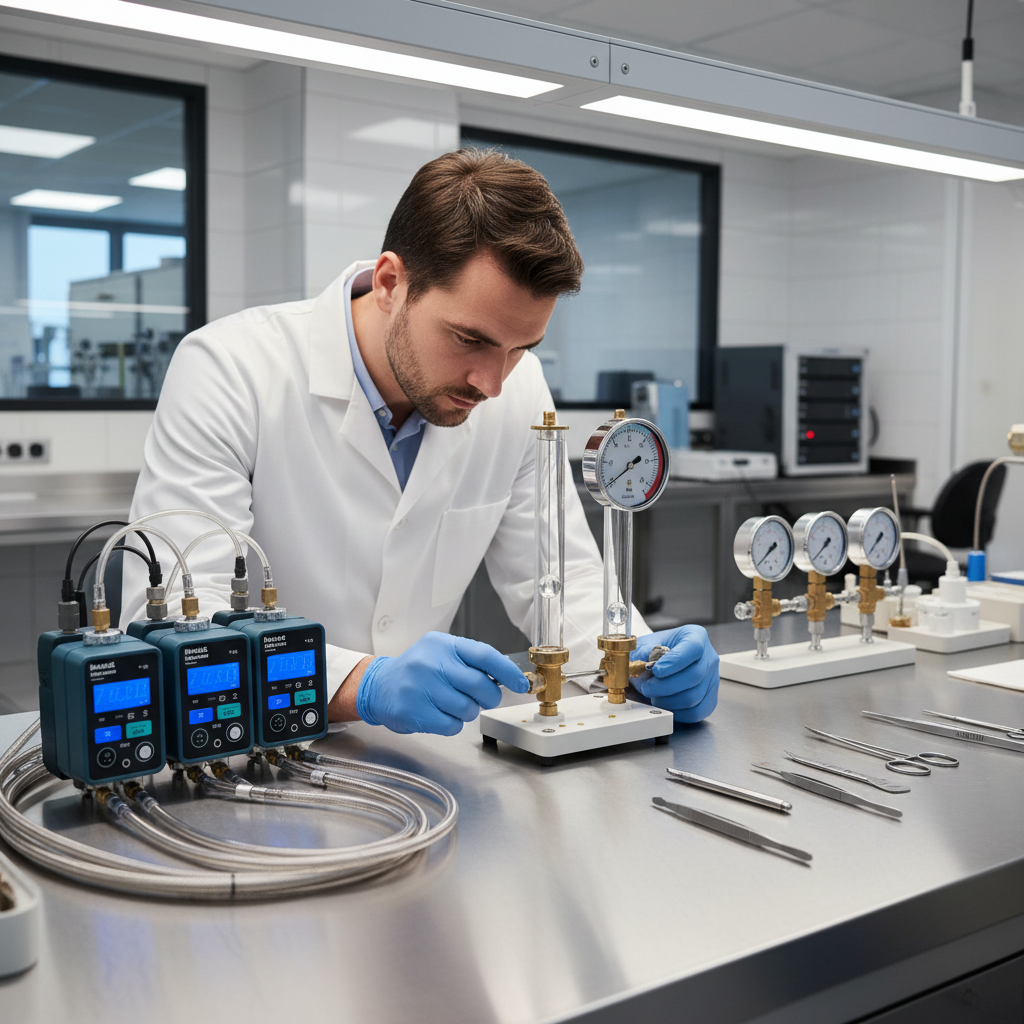
Medical Testing Solutions changes this dynamic. Through our dedicated dental flowmeter repair and calibration services, Atlanta dental offices bypass middlemen. For a predictable, flat rate of $750, your flowmeter receives a full teardown, ultrasonic cleaning, internal seal rebuild, safety fail-safe testing, NIST-traceable gas calibration, and recertification.
Why Flowmeters Drift: Common Failure Modes & Clinical Risks
Dental flowmeters operate in demanding clinical environments. Over years of daily operation, mechanical components degrade under high-pressure gas cycling, internal O-rings dry out, and ambient particulates settle into sensitive pneumatic blocks.
Understanding what fails inside an analog or digital flowmeter highlights why specialized, ASSE-compliant bench testing is non-negotiable.
1. Oxygen Fail-Safe Valve Breakdown
The most critical safety feature of any dental nitrous oxide flowmeter is the oxygen fail-safe mechanism (dictated by CGA and ADA standards). If the 50 PSI medical oxygen supply drops or fails completely, the fail-safe valve must instantly shut off nitrous oxide delivery to prevent delivering a hypoxic gas mixture to the patient. Over time, internal diaphragm springs lose tension, and elastomeric seats harden, causing the fail-safe to stick open or leak gas internally.
2. Canister and Flow Tube Seal Degradation
Analog units (such as the Porter MXR or Accutron Newport) use precision glass flow tubes suspended between manifold blocks. High-pressure viton or nitrile O-rings seal the top and bottom of these glass tubes. As these seals age, microscopic cracks develop, causing ambient nitrous oxide leakage into operatory breathing zones and drifting flow readings.
3. Ratio-Control Cam and Gear Wear
On percentage-mixing units like the Porter MXR, mechanical cams synchronize the dual control knobs to ensure oxygen concentrations never drop below a safe 30% threshold. Mechanical friction causes wear on these gears. If gears slip or drift out of alignment, the percentage dial reading on the faceplate no longer reflects the true volumetric gas concentration delivered to the patient circuit.
4. Pressure Regulator Creep
Internal secondary regulators stabilize fluctuating wall supply pressures down to working bench pressures. Diaphragms in these miniature regulators suffer from "regulator creep", a condition where supply pressure slowly leaks past the seat, over-pressurizing the glass flow tubes and bag mount stems, presenting severe rupture and leakage hazards.
Why this matters for compliance: Under NFPA 99 (Health Care Facilities Code), Category 2 and 3 dental gas systems require regular maintenance to verify that gas-specific delivery mechanisms do not leak hazardous gases into enclosed patient treatment rooms. Routine bench calibration eliminates exposure risks before they trigger regulatory citations or staff health hazards.
Flat-Rate $750 Repair vs. Local Service Middlemen
When Atlanta dental practices evaluate repair options, cost transparency and turnaround time are the two deciding factors. Traditional field service companies often charge unpredictable fees: a trip fee just to evaluate the unit, diagnostic fees, hourly bench rates, parts markups, and return shipping fees.
Medical Testing Solutions eliminates variable billing with a transparent, flat-rate $750 repair package.
| Feature / Metric | MTS Flat-Rate Dental Flowmeter Repair | Traditional Atlanta Dental Supply Rep | Local General Handpiece / Equipment Depot |
|---|
| Pricing Model | Flat-Rate $750 (all standard rebuild parts included) | Variable quote ($1,100 – $2,200+) or pushed to buy new ($4k+) | Hourly bench fee ($150-$225/hr) + parts markups |
| Typical Turnaround | Fast bench turnaround upon facility arrival | 4 to 8 weeks (shipped through vendor hubs) | 2 to 4 weeks (dependent on parts sourcing) |
| Brands Covered | Porter, Belmed, Accutron, Matrx (Analog & Digital) | Limited to brands they sell | Varies; often lack dedicated calibration fixtures |
| Technician Credentials | ASSE-Certified Medical Gas Specialists | Field sales techs / basic dental technicians | General repair mechanics |
| Calibration Standards | NIST-traceable mass flow verification & certification | Standard functional test (rarely NIST-traceable) | Visual bubble checks |
| Warranty | Comprehensive warranty on rebuild & parts | 30–90 days limited | 30 days |
Brands We Service: Porter, Belmed, Accutron, and Matrx
Every major brand of dental sedation flowmeter uses distinct pneumatic architecture. Our service center maintains genuine OEM components, specialized diagnostic jigs, and digital mass flow analyzers designed for each manufacturer’s specifications.
| Diagram text |
|, |
| Dental Flowmeter Rebuild & Recertification Matrix |
Porter Instrument (MXR, MXR-1, 3400)
Porter flowmeters are regarded as the gold standard of analog reliability, but their precision ratio mixing blocks require micro-inch tolerances during reassembly.
- We service the classic Porter MXR, MXR-1, and cabinet/wall-mount configurations.
- Common rebuild steps include rebuilding the dual-cam ratio system, replacing high-pressure inlet check valves, and setting the strict 30% minimum O2 safety mechanical stop.
Belmed (PC-7, PC-7 Dual, Ultra PC)
Belmed flowmeters feature robust pneumatic manifolds, but internal needle valves are prone to thread galling and seat pitting over time.
- We repair Belmed PC-7, PC-7 Cabinet, and portable stand units.
- Service includes replacing the primary flow control stems, installing new front-panel control valves, rebuilding the O2 emergency flush button, and verifying the fail-safe diaphragm.
Accutron (Newport, Digital Ultra, Compact)
Accutron units range from dependable dual-tube analog heads to sophisticated microprocessor-controlled digital units.
- We service the Accutron Newport, PC4, and Accutron Digital Ultra.
- Digital models undergo electronic solenoid valve inspection, optical sensor diagnostic routines, electronic safety alarm verification, and digital-to-analog pneumatic tracking calibration.
Matrx / Parker Hannifin (MDM, Quantiflex)
The Matrx MDM (Mixer-Dosimeter Model) is one of the most widely used ratio-control flowmeters in Atlanta oral surgery practices.
- We service Matrx MDM, MDM-D, and Quantiflex units.
- Rebuilds focus on eliminating internal cross-talk between the O2 and N2O mixing chambers, seating the mixer valve spool, and rebuilding the emergency air intake valve.
If you are upgrading equipment across your operatory or expanding a multi-suite surgical clinic, you can also explore our complete medical gas products catalog for certified delivery heads, hoses, regulators, and manifold alarms.
Step-by-Step: The $750 Precision Rebuild Process
When your package arrives at our medical gas facility from Atlanta, it undergoes a structured, documented restoration procedure. Here is what happens to your flowmeter during a complete rebuild:
1. Inbound Diagnostic & Baseline Leak Test
Before disassembly, the flowmeter is mounted to a test bench connected to pure dry nitrogen supply at 50 PSI. Technicians document initial flow drift, verify whether the oxygen flush reaches the required 45–50 L/min flow rate, and use calibrated helium mass spectrometry or high-sensitivity pressure decay methods to identify internal cross-leaks.
2. Complete Teardown & Decontamination
The head unit is completely disassembled down to its base manifold block. All mechanical fasteners, knobs, O-rings, internal diaphragms, and flow tubes are removed. Metal manifold bodies are placed into an industrial ultrasonic tank containing medical-grade degreasers to remove dried particulate matter, oil traces, and scale without etching the brass or aluminum surfaces.
3. Replacement of Critical Internal Wear Parts
All elastomeric seals, Viton O-rings, diaphragm gaskets, and high-pressure check valve springs are discarded and replaced with brand-new OEM components. Worn needle valve seats and stem packings are replaced to ensure silky-smooth adjustment without operational drift.
4. Precision Mechanical Alignment & Reassembly
The flowmeter is reassembled using calibrated torque drivers to avoid warping the manifold block or cracking glass flow tubes. On ratio models (Porter MXR, Matrx MDM), the mechanical link gears are indexed and aligned to exact manufacturer factory marks.
5. NIST-Traceable Calibration & Fail-Safe Verification
The reassembled unit is connected to calibrated digital mass flow meters. We measure volumetric accuracy across multiple delivery rates:
- Minimum flow settings (1.0 L/min to 2.5 L/min)
- Standard clinical ranges (5.0 L/min to 8.0 L/min)
- Maximum output delivery (10+ L/min)
Technicians verify that when the oxygen supply is disconnected or drops below 25 PSI, the nitrous oxide stream drops to zero immediately. We also verify that total oxygen delivery cannot be dialed below 30% concentration under normal operating parameters.
6. Recertification Documentation & Secure Return Shipping
Once bench testing is verified, our technicians issue an official Calibration & Compliance Certificate containing the unit's serial number, calibration date, technician identification, and testing parameters. The flowmeter is custom-packed in shock-absorbent foam packaging and returned via tracked, insured express shipping back to your Atlanta practice.
Compliance Standards: NFPA 99, ASSE, and ADA Guidelines
Operating conscious sedation equipment in Georgia is not merely an internal clinical matter, it is heavily regulated by state boards, fire marshals, and healthcare safety codes.
| Diagram text |
|, |
| Regulatory & Safety Standards |
| NFPA 99 Mandates inspection of nonflammable medical gas |
| (Health Care Code) systems, piping, and Category 2/3 delivery heads |
| Georgia Board of Enforces safe conscious sedation gear standards, |
| Dentistry (Rule 150) fail-safe shutoffs, and nitrous scavenging |
| ASSE Series 6000 Sets credentialing standards for medical gas |
| Professional Stds installers (6010), verifiers (6030), technicians |
| CGA Standards Compressed Gas Association guidelines for gas- |
| (Pamphlets G-4, V-1) specific fittings, connections, and cleanliness |
NFPA 99 Health Care Facilities Code
NFPA 99 sets the baseline for medical gas systems in dental and medical clinics. Chapter 5 governs Category 2 and Category 3 piping, storage, and administration equipment. Under these rules, medical gas systems and their administration points must undergo recurring functional testing to prove integrity. When dental flowmeters leak or fail to vent properly, they violate the life-safety mandates outlined in these NFPA standards.
Georgia Board of Dentistry Regulations
The Georgia Board of Dentistry explicitly outlines standards for conscious sedation permits (Georgia Administrative Code Rule 150-13). Dentists utilizing nitrous oxide inhalation sedation must maintain operating equipment with fail-safe mechanisms ensuring a minimum 30% oxygen concentration. If a clinic experiences a clinical emergency and investigators discover an uncalibrated flowmeter lacking current documentation, the practice faces immediate license suspension, fines, and civil exposure.
Leaking dental flowmeters release trace nitrous oxide into operatory air throughout the workday. NIOSH establishes a Recommended Exposure Limit (REL) of 25 ppm for nitrous oxide during anesthetic administration. A single dry O-ring on a flowmeter head can push operatory ambient levels above 200 ppm, exposing dental hygienists, assistants, and dentists to chronic reproductive and neurological health hazards.
To ensure complete operatory safety alongside flowmeter servicing, clinics frequently integrate our waste anesthetic gas (WAG) chemical vapor monitoring programs to verify low ambient exposure levels.
Furthermore, if your Atlanta facility is expanding, adding surgical operatories, or remodeling pipeline feeds, our team provides full medical gas certification and on-site medical gas verification under ASSE 6030 guidelines, as well as factory-spec medical gas installation per ASSE 6010 codes.
How Atlanta Dental Practices Can Pack and Ship Their Flowmeter
Shipping your flowmeter from Atlanta to our specialized bench facility is fast, straightforward, and secure. Follow these steps to ensure safe transit:
| Diagram text |
|, |
| Flowmeter Preparation & Shipping Protocol |
1. Disconnect and Depressurize
- Shut off the central oxygen and nitrous oxide pipeline zone valves or tank regulators.
- Depress the emergency oxygen flush button and open the gas valves to bleed all residual pressure from the operatory lines.
- Disconnect the diameter-index safety system (DISS) or quick-connect hoses from the back or bottom of the flowmeter head.
2. Remove the Head Unit
- Loosen the mounting thumb screw or collar that holds the flowmeter head to its wall-mounted swivel arm, cabinet slide, or portable mobile stand.
- Lift the flowmeter head free. (You do not need to ship the rolling stand, heavy mounting arms, or dual gas supply hoses unless you suspect a hose rupture).
- Leave the glass flow tubes, knobs, and bag mount stem attached to the head unit.
3. Package Securely
- Wrap the entire flowmeter head in at least two to three layers of heavy-duty bubble wrap, taping it tightly to secure the glass flow tubes and knobs against impact.
- Place the wrapped unit into a sturdy cardboard box with at least 2 inches of packing peanuts or dense foam surrounding all sides.
- Place a printout of your practice details (practice name, contact person, phone number, return shipping address, and a brief note on any known issues) inside the box.
- Seal with heavy-duty packaging tape and dispatch via UPS, FedEx, or USPS with tracking and insurance.
Preventive Maintenance: Extending Flowmeter Lifespan
Once your reconditioned flowmeter returns to your Atlanta clinic, establishing proactive maintenance protocols will keep the unit operating accurately for years.
- Daily Morning Inspection: Visually inspect glass tubes for cloudiness, moisture, or particulate matter. Turn on your pipeline system and listen for audible hissing around rear gas fittings and front valve seals.
- Monthly Fail-Safe Verification: During routine staff meetings, disconnect the central oxygen hose while both gases are flowing at 50%. The nitrous oxide float ball must drop to zero immediately. If it lingers or continues bubbling, contact an ASSE-certified technician immediately.
- Scavenging Flow Checks: Ensure your vacuum scavenging system pulls between 45 L/min and 50 L/min of flow. Under-scavenging exposes your team to excess ambient nitrous; over-scavenging pulls gas directly out of the patient mask before they can achieve sedation, leading staff to over-administer nitrous oxide.
- Annual System-Wide Checkups: Pair bench flowmeter calibration with comprehensive facility checkups through our annual medical gas inspections and recurring medical gas maintenance services to ensure pipe headers, zone valves, and alarms perform within NFPA guidelines.
Partner With ASSE-Certified Medical Gas Professionals
Don't let an uncalibrated, leaking nitrous oxide flowmeter threaten patient safety, compromise operatory revenue, or trigger state compliance citations. Medical Testing Solutions delivers predictable pricing, rapid turnaround, and ASSE-certified technical expertise to dental practices throughout Atlanta, Georgia.
Whether you need a single Porter MXR rebuilt, your Accutron digital units calibrated, or a complete facility-wide inspection of your medical gas delivery systems, our team is ready to help.
Restore your operatory with flat-rate $750 dental flowmeter repair today.