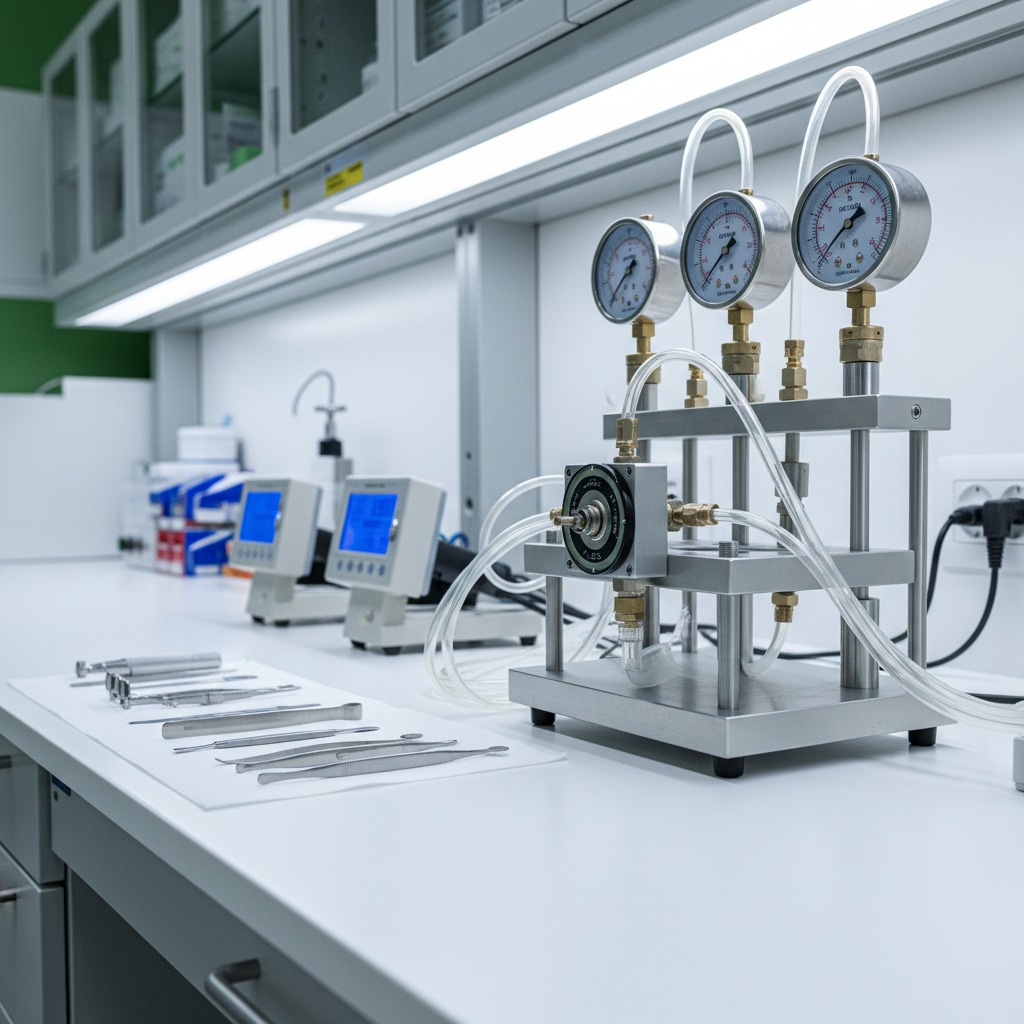
Dental Flowmeter Calibration Las Vegas NV: Fast NIST Service
Nitrous oxide conscious sedation remains one of the safest, most effective ways to manage patient anxiety in modern dental operatories. However, delivering precise gas concentrations requires strictly maintained dispensing hardware. For clinicians in Southern Nevada, securing accredited dental flowmeter calibration in Las Vegas, NV ensures patient safety, clinical efficacy, and defensible compliance under state and federal safety codes. A drift of even 5% in gas concentration can lead to inadequate sedation, hypoxia risks, or prolonged recovery times.
Medical Testing Solutions provides precision NIST-traceable calibration and factory-grade bench testing for Las Vegas practices with a rapid 5-day turnaround for a flat $450 rate. In this comprehensive guide, you will learn the regulatory standards governing inhalation sedation systems (including NFPA 99 and ASSE standards), how calibration drift occurs, the mechanical versus digital points of failure across top flowmeter brands, and the step-by-step bench testing process required to keep your practice audit-ready.
1. Why Routine Dental Flowmeter Calibration Matters in Las Vegas Operatories
Las Vegas dental practices face distinct environmental and operational challenges. The Mojave Desert's arid climate, paired with non-stop HVAC cycling across high-volume practices in Summerlin, Henderson, and central Las Vegas, accelerates the degradation of internal elastomeric seals, O-rings, and micro-orifice filters within your medical gas delivery hardware.
When a nitrous oxide delivery unit loses precision, the consequences range from compromised patient comfort to critical life-safety events. Modern flowmeters are engineered to prevent hypoxic gas delivery by establishing an absolute fail-safe floor, traditionally an engineered minimum of 30% oxygen ($O_2$) and a maximum ceiling of 70% nitrous oxide ($N_2O$). Over months of continuous clinical use, mechanical friction, pressure spikes from pipeline manifolds, and particulate migration shift these baseline thresholds.
Clinical outcomes depend entirely on volumetric accuracy. If your digital or mechanical flowmeter indicates an administration ratio of 50% $N_2O$ and 50% $O_2$, but internal mechanical resistance restricts oxygen flow, your patient may receive an unintended, hyper-concentrated dose of nitrous oxide. Conversely, restricted nitrous delivery leads to ineffective sedation, patient agitation during surgical procedures, and lost operatory production.
Routine bench testing and calibration eliminate guesswork. Utilizing certified dental flowmeter repair and calibration services guarantees that the physical volume of gas exiting the mixed gas outlet exactly matches the dial or digital readouts on your operatory unit.
Why this matters for compliance:
The Nevada State Board of Dental Examiners requires all practitioners administering nitrous oxide inhalation sedation to maintain equipment in safe operating condition. An uncalibrated flowmeter failing to deliver required minimum oxygen concentrations constitutes a direct violation of standard of care, exposing practices to administrative discipline and professional liability during adverse event audits.
2. Regulatory Standards: NFPA 99, ASSE, and ADA Guidelines
Medical gas delivery is strictly governed by national codes designed to protect patients, staff, and physical facilities. Dental practices are not exempt from these life-safety mandates. | Diagram text | |, | | NFPA 99 Health Care Facilities | | (Category 3 & Category 4 Dental Gas) | | ASSE 6000 Series Codes Scavenging & Ventilation | | • ASSE 6010: Installation • NIOSH REL: 25 ppm TWA | | • ASSE 6030: Verification • NFPA 99: Active Scavenging | | • ASSE 6040: Maintenance • Waste Gas Evacuation Check |
NFPA 99: Health Care Facilities Code
NFPA 99 categorizes dental medical gas and vacuum systems primarily under Category 3 (where system failure causes discomfort or minor injury) and Category 4 (where system failure has no direct clinical impact). However, if your Las Vegas surgical or pediatric suite administers moderate sedation, deep sedation, or general anesthesia, the operatory instantly falls under Category 1 or Category 2 mandates.
Under NFPA 99 Chapter 5, gas delivery equipment must undergo scheduled inspection, leak testing, and operational verification. Inhalation delivery systems must feature an integrated safety interlock that immediately terminates nitrous oxide delivery if the oxygen supply line pressure drops below 40 psig (±5 psig).
ASSE 6000 Series Professional Qualifications
Medical Testing Solutions adheres strictly to the ASSE 6000 standard. The personnel handling, inspecting, and servicing your infrastructure are credentialed across critical benchmarks:
- ASSE 6010: Certified technicians for medical gas installation.
- ASSE 6030: Non-biased inspectors who validate new or modified systems via comprehensive medical gas verification.
- ASSE 6040: System maintenance professionals managing active hospital and clinical facility systems through routine medical gas maintenance services.
Ensuring your flowmeter calibration is completed by ASSE-trained specialists guarantees that the factory testing protocols mirror the rigorous standards required across hospital-grade anesthesia systems.
NIOSH and ADA Scavenging Mandates
The National Institute for Occupational Safety and Health (NIOSH) establishes a Recommended Exposure Limit (REL) of 25 ppm for nitrous oxide as a time-weighted average (TWA) during anesthetic administration. Flowmeter calibration includes dynamic pressure decay and manifold leak testing. An internal leak within an operatory flowmeter exposes dental hygienists, assistants, and clinicians to chronic ambient $N_2O$, which has been clinically linked to reproductive complications, neurological issues, and reduced psychomotor performance. Paired with waste anesthetic gas (WAG) chemical vapor monitoring, calibration eliminates unmonitored leaks inside the operatory envelope.
3. Anatomy of Flowmeter Drift: What Fails Inside the Unit
A dental flowmeter is a precision fluidics control device. Whether your unit is a classical glass-tube mechanical rotameter or a modern microprocessor-driven digital mixer, it relies on finely machined parts operating under constant gas pressures ranging from 45 to 55 psig. | Diagram text | |, | | [Pipeline Gases: O2 @ 50 psig N2O @ 50 psig] | | Gas Diameter-Indexed (DISS) | | Inlet Check Valves & Strain | | Proportioning / Mixing Disk ◄── Mechanical Drift Point (Friction/Debris) | | 30% O2 Fail-Safe Safety ◄── Critical Failure Point (Spring Fatigue) | | Pressure Differential Diaph. |
1. Proportioning Valve Wear
Mechanical flowmeters rely on counter-geared proportioning valves. Rotating the single concentration knob simultaneously adjusts two distinct needle valves or a precision slide plate to alter the relative ratios of $O_2$ and $N_2O$. Over years of torque and micro-vibrations, the mechanical backlash in the control gear train shifts. A dial set to 40% $N_2O$ may mechanically open the nitrous port to an equivalent of 52%, creating an undetected overdose condition.
2. Rotameter Tube Internal Contamination
In traditional analog flowmeters, gas flows upward through a vertically tapered borosilicate glass tube, elevating a precision-weighted float (often an anodized aluminum ball or a silver-fluted float). Contaminants within pipeline gases, such as desiccant dust from aged air compressors, particulate pipe scale, or degraded hose linings, deposit onto the glass walls and float surfaces. This alters the float's hydrodynamic drag coefficient, causing the ball to hang or stick, displaying an inaccurate volume indicator.
3. Fail-Safe Diaphragm Degradation
The fail-safe system relies on an elastomeric pressure-sensing diaphragm. Nitrous oxide flow is permitted across a pilot seat only when positive pressure from the oxygen supply acts upon the opposite side of this diaphragm. In dry environments like Las Vegas, synthetic rubbers (such as nitrile, neoprene, or silicone) dry out, stiffen, or develop microscopic pinhole perforations. If this diaphragm stiffens, the unit may fail to shut off nitrous oxide when oxygen pressure collapses.
4. Digital Microprocessor and Solenoid Drift
Modern digital flowmeters use high-frequency pulse-width modulated (PWM) micro-solenoids and mass flow sensors to govern gas mixing. While digital units eliminate gear-train backlash, they introduce electronic vulnerabilities:
- Thermal zero-point drift in solid-state pressure transducers.
- Particulate buildup on heated-wire mass airflow sensors.
- Solenoid plunger seal deformation, causing micro-leakage when the unit is powered off.
4. Brand-by-Brand Analysis: Accutron, Porter, Belmed, and Matrx
Every major brand of conscious sedation flowmeter utilizes proprietary internal geometry and mechanical architectures. At Medical Testing Solutions, bench calibrations address these model-specific design considerations.
| Flowmeter Model | Architecture Type | Factory Tolerances | Primary Failure Modes |
|---|---|---|---|
| Accutron Digital | Digital Solenoid / | Flow: +/- 5% of Scale | Mass flow sensor drift; digital |
| Ultra PC | Micro-processor | Ratio: +/- 2% Actual | touch-membrane calibration loss |
| Accutron Ultra | Analog Dual Rotameter | Flow: +/- 5% of Scale | Tube float sticking; gear lash on |
| PC % Cabinet | with Proportioner | Min O2: 30% (+/- 1%) | mixture control dial |
| Porter MXR-1 / | Mechanical Precision | Flow: +/- 5% of Scale | Glass tube base O-ring dry rot; |
| MXR-D | Dual Flow Block | Min O2: 30% absolute | fail-safe spring calibration fatigue |
| Belmed PC-7 / | Analog Dual | Flow: +/- 5% of Scale | Internal check valve back-leakage; |
| PC-5 | Rotameter Columns | Ratio: +/- 3% Total | flow tube cracking under stress |
| Matrx by Parker | Mechanical & Digital | Flow: +/- 5% of Scale | Single-knob proportioning cam wear; |
| (MDM / Digital) | Hybrid Variations | Min O2: 30% absolute | bag tee valve seal breakdown |
Accutron (Digital Ultra PC & Ultra PC %)
Accutron units are widespread across Nevada practices. The Digital Ultra PC requires electronic sensor realignment using calibrated nitrogen and pure oxygen standards. Technicians verify the digital LED readouts against primary mass flow instruments, resetting the baseline voltage output of internal sensors. Analog Ultra PC models require mechanical centering of the gear-coupled dials and replacement of the micro-screen inlet filters.
Porter Instrument (MXR-1 and Digital Solutions)
Porter is revered for rugged mechanical precision. The MXR-1 features a patented glass-tube mechanical design with integrated proportioning. Servicing a Porter requires checking the precision spring tension within the safety shut-off valve assembly and verifying the oxygen flush valve delivery rate, which must instantly supply a minimum of 30 L/min to 50 L/min of pure oxygen under emergency conditions without pressure drop.
Belmed (PC-7 and PC-5 Series)
Belmed flowmeters utilize clean, dual-flow tube engineering. These workhorse systems typically encounter O-ring embrittlement around the glass tube manifolds and inlet check-valve back-leakage. Calibration on a Belmed ensures that when the nitrous dial is closed, internal back-pressure cannot force residual $N_2O$ through the non-return check valves into the breathing circuit.
Matrx / Parker Hannifin (MDM Series)
The Matrx MDM (Mixer Dental Model) was among the earliest continuous-flow proportioners. The mechanical MDM utilizes a complex cam-driven proportioning valve. Over time, the cam wears flat along high-use sectors (typically between 30% and 50% nitrous), resulting in non-linear gas delivery. Calibration verifies cam response across the entire rotational spectrum from 0% to 70% $N_2O$.