Skip to content
    New: Medical Gas Outlet Retrofit & Rebuild Matrix — cross-reference legacy Chemetron, Ohio Diamond, Puritan-Bennett & more →
    ASSE Certified 24/7
    Medical Gas Service
    Compliance & Standards

    Dental Flowmeter Calibration Hartford CT: Reliable Nitrous Safety

    Medical Testing SolutionsOctober 31, 202612 min read
    Share
    Dental Flowmeter Calibration Hartford CT: Reliable Nitrous Safety

    Dental Flowmeter Calibration Hartford CT: Reliable Nitrous Compliance

    Every dental practice administering nitrous oxide-oxygen minimal sedation in Connecticut carries a strict clinical and legal responsibility: ensuring patient delivery ratios are unerringly accurate. Nitrous oxide flowmeters are precision pneumatic instruments. Over months of routine clinical cycles, internal mechanical diaphragms, flow tubes, needle valves, and fail-safe safety interlocks fall out of baseline manufacturer tolerance.

    For dental practitioners across Hartford County, from downtown Hartford and West Hartford to Farmington, Glastonbury, and Manchester, maintaining verified equipment protects patients from hypoxia, safeguards staff from occupational exposure, and keeps the practice compliant with state and national codes.

    In this comprehensive guide, you will learn the regulatory standards governing nitrous oxide delivery, the specific failure points inside modern dental flowmeters, the difference between field functional testing and laboratory NIST-traceable calibration, and how Medical Testing Solutions delivers flat-rate $450 calibration with a guaranteed 5-day depot turnaround for Hartford-area dentists.


    The Regulatory Framework: Why Calibration Is Mandatory in Connecticut

    Dental practices do not operate in a regulatory vacuum. In Hartford, dental sedation systems sit at the intersection of municipal building codes, state licensing boards, federal workplace safety rules, and national fire protection mandates.

    When your practice administers inhalation analgesia, your delivery devices must satisfy multiple oversight bodies:

    1. NFPA 99 (Health Care Facilities Code): Under NFPA 99 Chapter 15 (Dental Gas and Vacuum Systems), piped dental gas delivery systems and station outlets are governed by Category 3 or Category 2 requirements depending on the sedation depth. NFPA 99 dictates that sedation equipment must be maintained and verified to manufacturer specifications annually.
    2. Connecticut Department of Public Health (DPH): The Connecticut State Dental Commission requires all dentists holding conscious sedation or anesthesia permits to maintain their equipment in proper operational condition, with complete documentation of equipment testing and inspection logs available upon audit.
    3. OSHA & NIOSH Occupational Limits: Under the General Duty Clause and NIOSH recommendations, operating dental personnel must not be subjected to ambient nitrous oxide levels exceeding 25 ppm time-weighted average (TWA) during administration. An uncalibrated or leaking flowmeter is the primary driver of ambient operatory contamination.
    4. ASSE Series 6000 Standards: Equipment testing and system maintenance should align with standards established by the American Society of Sanitary Engineering (ASSE).

    Why this matters for compliance: Failing to produce an up-to-date, NIST-traceable calibration certificate during a Connecticut DPH inspection or following an adverse patient event can result in immediate permit suspension, civil liability, and voided professional malpractice coverage.

    Routine clinical practice demands precise gas delivery. Ensuring your sedation system is serviced via professional dental flowmeter repair and calibration guarantees legal compliance and peace of mind.


    Anatomy of a Dental Flowmeter: Critical Failure Points

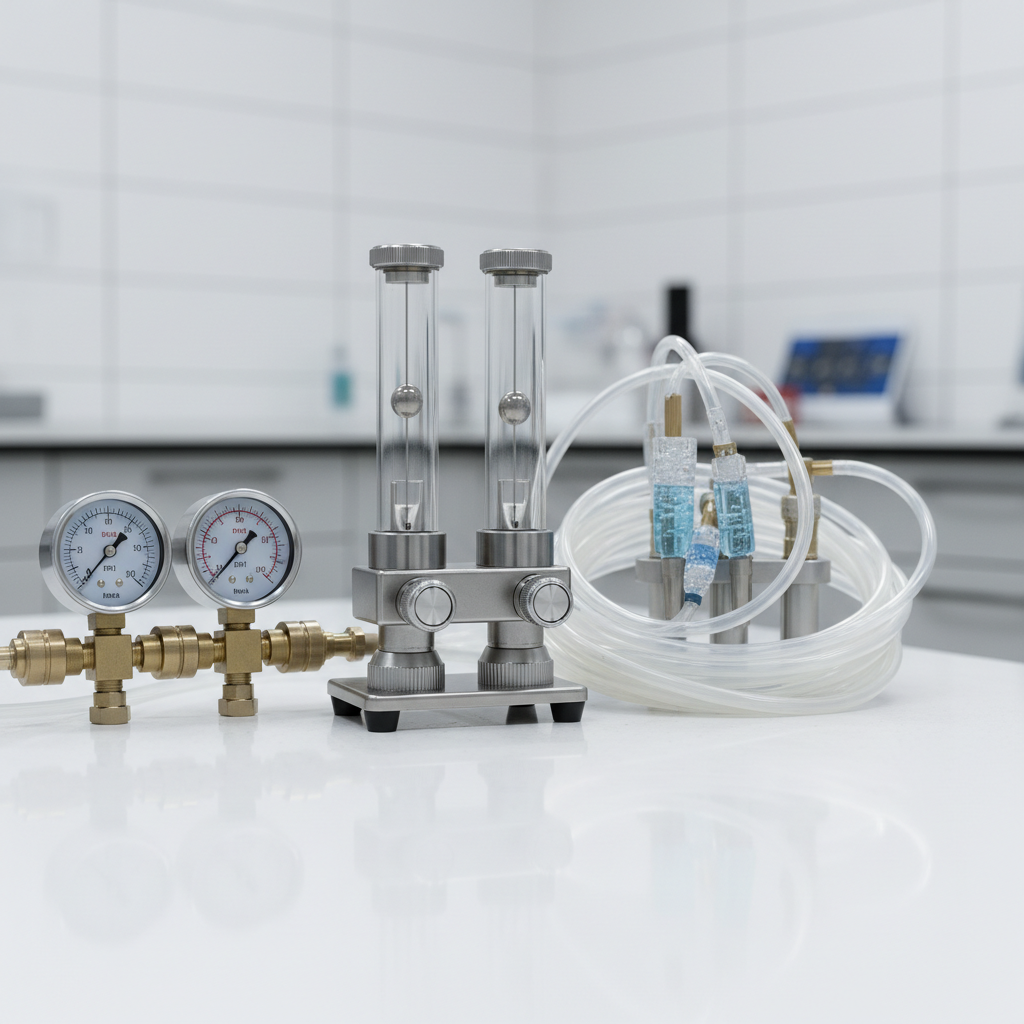
    Whether your Hartford clinic utilizes an analog dual-tube unit or a digital touchscreen mixer, flowmeters rely on mechanical and micro-pneumatic assemblies exposed to extreme pressure differentials (typically 50–55 psig pipeline input). Over time, repeated pressure cycling, trace particulates, and drying elastomeric seals cause system drift. | Diagram text | |, | | 50-55 PSIG Pipeline / Tank | | [ Fail-Safe Valve ] → - (Mechanical Lockout), + |

    1. The Proportional Fail-Safe Interlock

    The single most critical life-safety component inside any dental flowmeter is the mechanical or pneumatic fail-safe mechanism (such as the Matrx or Porter proportioner). This system physically blocks nitrous oxide delivery if the oxygen supply pressure drops below safe operational limits (typically under 30 psig) or if the delivered oxygen ratio drops below 30%. If this internal valve binds, sticks, or suffers spring fatigue, it creates a potential condition where a patient could receive a hypoxic gas mixture without warning.

    2. Needle Valves and Valve Seats

    Rotary knobs control microscopic gas orifices. Clinicians frequently over-tighten these knobs upon shutdown, deforming the brass or stainless steel needle against the seating surface. This leads to seat scoring, baseline leakage, and non-linear flow curves, meaning the dial reading will no longer reflect the actual flow delivered to the breathing circuit.

    3. Glass Flow Tubes and Float Balls

    In traditional flowmeters, gas elevates precision-machined float balls inside tapered glass tubes. Micro-debris from aged copper piping or deteriorated gas cylinder washers can bypass intake filters, coating the glass walls with friction-inducing films. Floats begin to stick or lag, misleading the dental provider regarding true volumetric displacement.

    4. Digital Flow Sensors and Transducers

    Modern digital units (such as the Accutron Digital Ultra or Porter MXR-D) utilize micro-electro-mechanical mass flow sensors. While free from mechanical float sticking, their electronic calibration parameters drift across thermal cycles, requiring diagnostic re-zeroing and multi-point calibration against verified laminar flow standards.

    5. Internal Check Valves and O-Rings

    Drying nitrile and fluorocarbon O-rings along internal manifolds cause dangerous cross-gas leakage or room-air aspiration. When internal seals degrade, unmetered nitrous escapes into the cabinet chassis and enters operatory breathing zones, driving ambient concentrations far beyond allowable thresholds. For practices concerned about occupational limits, combining equipment recertification with routine waste anesthetic gas monitoring is essential.


    Bench Calibration vs. Field Functional Testing: Understanding the Difference

    Many mobile service technicians claim to "certify" dental flowmeters on-site inside your operatory in 15 minutes. It is vital for dental directors to understand why an on-site field check does not equal a true laboratory NIST-traceable calibration. | Diagram text | |, | | BENCH CALIBRATION vs. FIELD CHECK | | BENCH CALIBRATION (DEPOT LABORATORY) FIELD CHECK (MOBILE VAN / OPERATORY) | | Multi-point primary standard testing Single-point visual float assessment | | NIST-traceable primary flowmeters Handheld or uncalibrated test gauges | | Total manifold disassembly & reseal External spray leak detection only | | 24-hour static pressure decay test 2-minute dynamic observation | | Full fail-safe cut-off calibration Basic "turn-off-oxygen" functional test | | ISO/IEC 17025 traceable paper trail Generic pass/fail sticker without data points | An on-site functional test simply confirms: Does gas flow when the knob turns, and does the alarm sound when oxygen runs out? It does not measure whether 4.0 Liters Per Minute (LPM) on your dial is actually delivering 3.1 LPM or 4.9 LPM to the patient's lungs.

    True NIST-traceable bench calibration requires sending the unit to an environmentally controlled metrology facility. Here, primary standard mass flow meters, calibrated directly against National Institute of Standards and Technology physical artifacts, measure actual gas volume at standard temperature and pressure (STP). The technicians rebuild worn seals, realign needle valves, verify accuracy across 10% to 100% flow scales, and validate the oxygen flush mechanism at its mandated 30–60 LPM capacity.


    The Medical Testing Solutions $450 Hartford Protocol: 5-Day Turnaround

    Dental practices cannot afford weeks of operatory downtime. Medical Testing Solutions has engineered a streamlined depot calibration program specifically serving Hartford County practices, combining unmatched metrological precision with rapid logistics.

    For a flat fee of $450 per unit, MTS provides:

    • Complete Multi-Point Calibration: Calibration of both Oxygen and Nitrous Oxide channels across low, mid, and maximum flow rates.
    • Fail-Safe Operational Verification: Precise bench testing of safety interlock cut-offs down to fractional psig limits.
    • Internal Re-Sealing: Replacement of standard consumable manifold O-rings and inlet filter screens.
    • Oxygen Flush Validation: Verification of emergency O2 purge volumetric rates.
    • NIST-Traceable Certificate of Calibration: Complete formal documentation citing standard serial numbers, ambient test conditions, baseline as-found data, and post-calibration as-left readings.
    • 5-Day Turnaround: The unit leaves our depot within 5 business days of intake.

    Our specialists handle every leading industry make and model, including:

    • Porter Instrument: MXR, MXR-D, Porter Digital MD, Vanguard
    • Matrx / Midmark: Matrx MDM, Digital MDM, Matrx Quantiflex
    • Accutron: Digital Ultra, Ultra PC, Personal Inhaler Plus assemblies
    • Belmed: PC-7, PC-5, ClearView manifolds

    If your clinic requires pipeline source gas verification, our team also provides nationwide annual medical gas inspections to evaluate your central manifold, zone valves, and alarms alongside your operatory delivery heads.


    Technical Comparison: Leading Dental Flowmeter Systems

    Different flowmeter architectures present distinct calibration challenges. The table below outlines how leading brands compare in operation, typical failure points, and calibration requirements:

    Flowmeter Model / BrandTechnology TypePrimary Mechanical Failure ModeMinimum O2 ConcentrationRequired Service Interval
    Porter MXRMechanical Dual-Tube AnalogGear rack misalignment; needle seat grooving30% absolute baselineAnnual bench recalibration
    Matrx MDMMechanical Single-Dial MixerInternal proportioning cam wear; seal drying30% absolute baselineAnnual bench recalibration
    Accutron Digital UltraMicroprocessor Sensor DrivenSensor thermal drift; optical encoder error30% electronic lockoutAnnual digital recalibration
    Belmed PC-7Analog Dual-Tube RotameterFloat stick from particulate; manifold leak30% mechanical stopAnnual bench recalibration
    Porter Digital MDHybrid Digital/ElectronicSolenoid valve hysteresis; seal fatigue30% firmware/fail-safeAnnual calibration & update

    Regardless of brand, every unit relies on downstream vacuum scavenging. When calibrating flowmeters, dental facilities should also review their operatory vacuum line capacity. An inadequate vacuum line fails to draw away exhaled gasses, undermining the scavenging system. Our team can evaluate your central suction apparatus through professional medical gas maintenance services.


    Step-by-Step Procedure: Preparing Your Flowmeter for Calibration

    To minimize clinical interruption and ensure equipment arrives safely at our depot, follow this preparation checklist:

    Step 1: Disconnect and Purge Lines

    1. Shut off the local station outlet quick-connects or tank cylinder valves (both O2 and N2O).
    2. Turn both flowmeter knobs fully counterclockwise or hit the Oxygen Flush button to drain residual line pressure completely until all gauges read 0 psig.
    3. Disconnect medical gas high-pressure hoses (DISS or quick-connect fittings) from the rear or underside of the unit.

    Step 2: Remove the Flowmeter from Mounting Hardware

    1. Cabinet Mount: Loosen the rear thumb screws or release the locking bracket from the sliding shelf.
    2. Telescoping Wall Arm: Support the weight of the head, back out the retention pin or hex set-screws from the articulated arm, and lift the head free.
    3. Mobile Cart: Disengage the flowmeter head from the post adapter. Keep the cart base, regulators, and cylinder yokes securely stored at your Hartford practice; only the mixing head requires depot calibration.

    Step 3: Secure Critical Components

    • Remove the rubber breathing bag, corrugated tubing, and nasal hood/mask assemblies. These do not need calibration and can remain in your office.
    • Ensure control knobs are turned gently to their off positions (do not force closed).

    Step 4: Protective Packaging

    • Wrap the flowmeter head in at least three layers of heavy-duty bubble wrap, paying special attention to protruding control knobs and glass rotameter tubes.
    • Place the unit into a rigid, double-walled corrugated shipping box. Fill all voids with packing material to prevent any movement during transit.
    • Enclose your practice's contact information, sedation permit details, and return shipping address.

    Step 5: Depot Intake & Calibration

    Once received at the Medical Testing Solutions depot, your unit is logged into our quality system, subjected to primary standard evaluation, serviced, certified, and dispatched back to your Hartford address within our 5-day SLA.


    Hartford Dental Clinic Case Study: Restoring Compliance in Farmington

    A premier 12-operatory pediatric and family dental group in Farmington, CT (just 15 minutes outside downtown Hartford) was undergoing a routine compliance review ahead of their Connecticut State Dental Commission conscious sedation permit renewal.

    During internal preliminary checks, the clinical director noticed that one of their high-utilization analog mixing units produced variable float levels whenever the suction scavenger fluctuated. More concerning, ambient chemical badge monitors returned 8-hour time-weighted averages exceeding 110 ppm N2O in operatory corners, far above recommended thresholds.

    The clinic contacted Medical Testing Solutions. Rather than paying thousands of dollars for unnecessary full-unit replacements, the practice shipped four flowmeters to our depot under our staggered rotation protocol to maintain operatory capacity.

    Metrology Findings:

    • Unit 1 & 2: Severe needle seat grooving on the nitrous oxide channel, causing the units to deliver 14% to 18% higher N2O concentrations than indicated on the analog scale.
    • Unit 3: Deteriorated internal manifold gaskets resulting in continuous cabinet chassis gas leaks into the operatory space.
    • Unit 4: Oxygen fail-safe valve spring had seized from pipeline particulate buildup, failing to cut off nitrous flow when oxygen supply dropped below 25 psig.

    The Solution: Medical Testing Solutions rebuilt the manifold assemblies, installed factory-grade O-ring rebuild kits, cleared internal gas passages, and performed five-point NIST-traceable calibration on both gas circuits.

    Within the guaranteed 5-day depot turnaround, all four flowmeters were delivered back to Farmington with complete calibration certificates, detailed as-found/as-left metrology reports, and ASSE-standard test documentation. Subsequent ambient air testing showed room nitrous levels dropped below 12 ppm, and the practice passed their state sedation audit without a single citation.


    Comprehensive Facility Safety: Beyond the Flowmeter

    Calibrating the flowmeter head solves the delivery equation, but a dental facility's safety net is only as strong as its source supply and infrastructure. Piped medical gas systems require continuous vigilance from source to patient. | Diagram text | |, | | Complete Medical Gas Safety | If your Hartford dental practice is expanding, remodeling, or installing new piped nitrous oxide and oxygen lines, building codes mandate specialized third-party testing. Any new installations must be executed by certified personnel adhering to medical gas installation standards under ASSE 6010, followed by independent medical gas verification by an ASSE 6030 certified verifier prior to human use.

    Furthermore, ensuring staff safety requires ongoing verification of scavenger exhausts and vacuum pump sizing. High ambient levels of nitrous oxide can lead to reproductive complications, neurological symptoms, and cognitive impairment among dental hygienists and dental assistants exposed over months or years. Calibration directly eliminates hardware-induced leaks at the source.


    Schedule Your Hartford Flowmeter Calibration Today

    Don't wait for a state compliance audit, an erratic float tube, or staff complaints of chemical odor to address your nitrous oxide sedation systems. Medical Testing Solutions delivers the metrological accuracy, rapid turnaround, and certified ASSE-backed documentation Hartford dental practices need to operate safely and legally.

    Protect your patients, your staff, and your clinical practice with our flat-rate $450 NIST-traceable flowmeter calibration with a guaranteed 5-day turnaround.


    Frequently Asked Questions

    Under NFPA 99 Chapter 15 guidelines, manufacturer requirements, and Connecticut State Dental Commission standards, nitrous oxide flowmeters must undergo functional calibration and safety verification at least once every 12 months. High-volume dental practices should consider biannual testing.

    ASSE 6030 refers to the professional credential for verifying facility medical gas piping systems (manifolds, valves, alarms, outlets). Dental flowmeter calibration is the metrological certification of the patient delivery device itself, verifying flow accuracy against NIST standards. Medical Testing Solutions provides both services.

    No. Standard supply distributors typically only conduct external leak checks or visual float checks. True NIST-traceable calibration requires environmental bench testing with calibrated mass flow meters to ensure volumetric ratios conform to manufacturing tolerances.

    If your flowmeter exhibits broken castings, stripped needle valves, or obsolescence preventing calibration, Medical Testing Solutions immediately contacts you with detailed diagnostic notes and provides clear options for overhaul or replacement from our catalog.

    Keep a dedicated Medical Gas Equipment Compliance Binder containing the formal Certificate of Calibration for each flowmeter, displaying serial numbers, test dates, technician ASSE credentials, and as-left tolerance data. Retain records for at least 5 years.

    This article is provided for educational purposes and reflects industry standards as of publication. Always verify against current NFPA 99, CGA, and AHJ requirements. Medical Testing Solutions is ASSE-certified and ready to help — contact us for facility-specific guidance.

    Request a quote for your facility

    Talk with Medical Testing Solutions about your next inspection, repair or equipment request.

    Get a quote in 1 business day

    I agree to receive text messages from Medical Testing Solutions, L.L.C. at the phone number provided, including informational and marketing messages. Consent is not a condition of purchase. Message frequency varies. Message & data rates may apply. Reply STOP to opt out or HELP for help. See our Privacy Policy and Messaging Terms.

    Prefer to talk? Call (754) 315-1078

    Related articles