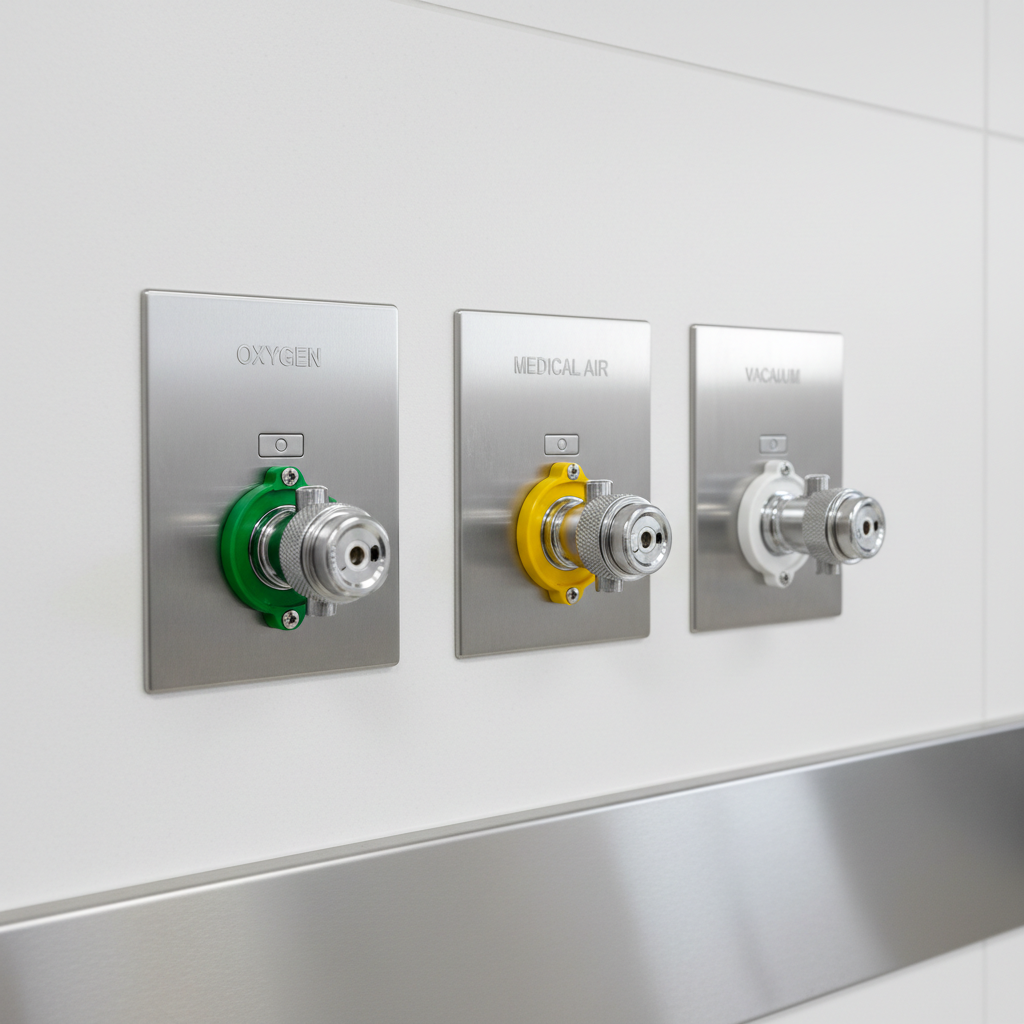
Amico Medical Gas Outlet Assembly Guide: Specs & Selection
The Amico medical gas outlet assembly is one of the most widely specified terminal units in modern healthcare construction and facility retrofits. Whether installed in general patient rooms, intensive care units, or surgical suites, medical gas outlets serve as the critical point of connection between central pipeline systems and life-support equipment. Selecting, installing, and maintaining the right terminal unit is not merely an architectural detail; it directly impacts clinical workflow, maintenance downtime, and regulatory compliance.
In this comprehensive guide, our ASSE-certified specialists at Medical Testing Solutions break down everything facility managers, biomedical engineers, and mechanical contractors need to know about the Amico medical gas outlet assembly catalog. You will learn the mechanical differences between console and wall configurations, how connection profiles impact cross-connection safety, key NFPA 99 compliance mandates, step-by-step installation practices, and how to source genuine Amico rough-in and finish assemblies for your next project.
What Is an Amico Medical Gas Outlet Assembly?
A medical gas outlet (or vacuum inlet) is the final delivery station in a piped medical gas distribution network. An Amico medical gas outlet assembly consists of two integrated sub-assemblies: the rough-in assembly (which brazes into the central pipeline network inside the wall or console) and the latch valve/finish assembly (the front-facing component containing the gas-specific mechanism, indexing pin configuration, and aesthetic trim plate).
Amico designs these assemblies for positive-pressure gases (Oxygen, Medical Air, Carbon Dioxide, Nitrous Oxide, Instrument Air) and vacuum systems (Medical-Surgical Vacuum, Waste Anesthetic Gas Disposal [WAGD]). Built with modularity in mind, Amico terminal units permit field-servicing of primary and secondary seals without shutting down the entire pipeline zone, maintaining uninterrupted service to adjacent patient beds.
Why this matters for compliance: NFPA 99 (Health Care Facilities Code) Section 5.1.5 requires each station outlet/inlet to be gas-specific, equipped with a primary and secondary check valve (for positive pressure), and tested to prevent cross-connection. Amico assemblies are 100% factory-tested for flow, leaks, and gas specificity to satisfy these stringent baselines before leaving the factory.
Core Components: Rough-In vs. Latch Valve (Finish) Assemblies
Understanding the modular construction of the Amico terminal unit simplifies both specification during new construction and procurement during renovation. | Diagram text | |, | | COMPLETE OUTLET ASSEMBLY | | ROUGH-IN ASSEMBLY LATCH VALVE / FINISH | | - 360-Degree Swivel Copper - Gas-Specific Faceplate | | - Secondary Check Valve - Primary Check Valve | | - Mounting Bracket / Box - Indexing Mechanism | | - Protective Plaster Cover - Color-Coded Labeling |
1. The Rough-In Assembly
The rough-in is installed during the rough framing phase by an ASSE 6010-certified medical gas installer. It includes:
- Copper Tube Extension: A 1/2-inch O.D. (3/8-inch nominal) type K copper stub that rotates 360 degrees for flexible piping connections from any direction.
- Secondary Check Valve: A spring-loaded seal that automatically prevents gas loss when the front latch valve is removed for maintenance.
- Mounting Plate/Backbox: Stamped galvanized steel or aluminum housing that anchors securely to wall studs, headwalls, or ceiling columns.
- Protective Mud Cap: A temporary cover that prevents drywall dust, paint, and construction debris from fouling the internal sealing surfaces before final trim-out.
2. The Latch Valve (Finish Assembly)
Installed during the trim phase, the latch valve establishes the final user interface. It contains:
- Primary Check Valve: Opens automatically when a compatible medical gas adapter is inserted and seals shut instantly upon disconnection.
- Gas-Specific Indexing: Mechanical keying (pins, threads, or geometric slots) designed in strict accordance with Compressed Gas Association (CGA) standards to make misconnection mechanically impossible.
- Color-Coded Trim Plate: High-impact, fire-retardant molded cover or brushed metallic plate labeled with the standardized gas name and CGA color coding (e.g., green for Oxygen, yellow for Medical Air, white for Vacuum).
When retrofitting older facilities, contractors can browse our products catalog to identify exact rough-in and finish assembly pairings that prevent pipeline downtime.
Amico Outlet Series: Wall vs. Console vs. Ceiling Configurations
Amico manufactures several series tailored to physical mounting constraints. Each variation maintains identical gas-specific indexing while adapting to structural requirements:
Wall Outlets (True-Line Series)
The standard for drywall construction, Amico wall outlets mount flush into standard architectural wall cavities. They feature a compact design that fits within standard 2x4 stud depths and incorporate an integrated bracket that aligns multiple gas services on precise center-to-center distances. This simplifies gang mounting when routing four to six gas services into a single headwall cavity.
Console Outlets
Engineered specifically for pre-fabricated patient headwalls, intensive care architectural beams, and custom service columns, console assemblies feature a narrower front profile. The console trim plate allows tight, horizontal or vertical clustering, preserving critical bedside real estate for electrical receptacles, patient monitoring cables, and nurse call systems.
Ceiling Columns and Track Assemblies
For operating rooms and trauma bays, ceiling-mounted drops place medical gases directly over the sterile field. Amico ceiling outlets feature heavy-duty retention springs to support downward-facing physiological loads without permitting adapter wobble or micro-leaks.
Connection Profiles: Quick-Connect vs. DISS
The primary operational decision when specifying an Amico medical gas outlet assembly is selecting the connection profile. Amico supports all dominant North American standards: | Diagram text | |, | | CONNECTION PROFILE SPECS | | Feature Ohmeda (Diamond) Chemetron DISS (1220 Series) | | Latch Type Push-button release Sliding latch Threaded screw-on | | Connection Speed Instantaneous Instantaneous Moderate (Thread) | | Security Level Standard Clinical Standard Clinical High Vibration | | Common Areas Med-Surg, ER, PACU Med-Surg, General OR, ICU, Anesthesia | | Flow Rating Exceeds NFPA 99 Exceeds NFPA 99 Exceeds NFPA 99 |
Diameter Index Safety System (DISS)
DISS outlets use threaded, dimensionally indexed metal fittings defined by CGA Pamphlet V-5. Because the connection is physically threaded and torqued down, DISS outlets eliminate the risk of accidental quick-release disconnections. Consequently, DISS is heavily favored in Operating Rooms, Cath Labs, and Critical Care units where ventilators and anesthesia machines must remain permanently anchored to gas drops.
Ohmeda (Diamond) Compatible
The Ohmeda-style quick-connect profile features a rectangular insertion geometry with a single push-button release mechanism. It is favored for general patient rooms and step-down units due to its one-handed insertion capability and rapid disconnect action.
Chemetron Compatible
Chemetron-style assemblies use a dual-latch mechanism with a mechanical sliding catch. Many facilities standardize on Chemetron to maintain compatibility across legacy hospital wings, preventing the capital expense of replacing hundreds of mobile suction regulators and flowmeters.
Puritan-Bennett (PB) Compatible
Featuring a distinctive non-interchangeable pin configuration, PB quick-connects provide rugged mechanical retention and are common in regional healthcare systems and specialized respiratory therapy departments.
Amico vs. Competitor Outlets: Specification Comparison
When specifying terminal units, mechanical contractors and hospital engineers frequently compare Amico against alternatives like Tri-Tech Medical, BeaconMedaes, and Ohio Medical. Below is a direct technical comparison:
| Technical Feature | Amico True-Line / Console | Tri-Tech Medical Series | BeaconMedaes Series |
|---|---|---|---|
| Pipeline Connection | 360° Swivel, 1/2" Type K Stub | Fixed / Multi-axis Option | Integral brazed copper stub |
| Secondary Check Type | Cartridge assembly, auto-shutoff | Spring-loaded secondary check | Threaded secondary assembly |
| Rough-in Flexibility | Universal base accepts any latch style | Brand-specific base plates | Brand-specific base plates |
| Maintenance Mechanism | Front-removable cartridge | Front-accessible O-rings | Dual O-ring front service |
| Flow Performance | > 170 LPM @ 50 psig drop < 5 psi | > 160 LPM @ 50 psig drop < 5 psi | > 165 LPM @ 50 psig drop < 5 psi |
| Mounting Capability | Gangs up to 1-inch thick plaster | Integrated ganging tabs | Modular bracket system |
| WAGD Options | High-flow venturi or passive line | Dedicated vacuum line | Venturi or dedicated vacuum |
The definitive engineering advantage of the Amico design is its universal rough-in module. An Amico rough-in accepts Ohmeda, Chemetron, Puritan-Bennett, or DISS latch valves interchangeably. If a hospital wing converts from Chemetron quick-connects to DISS threaded connections, biomedical technicians can simply swap out the front latch valve without cutting drywall, evacuating pipeline zones, or performing hot brazing inside clinical units.