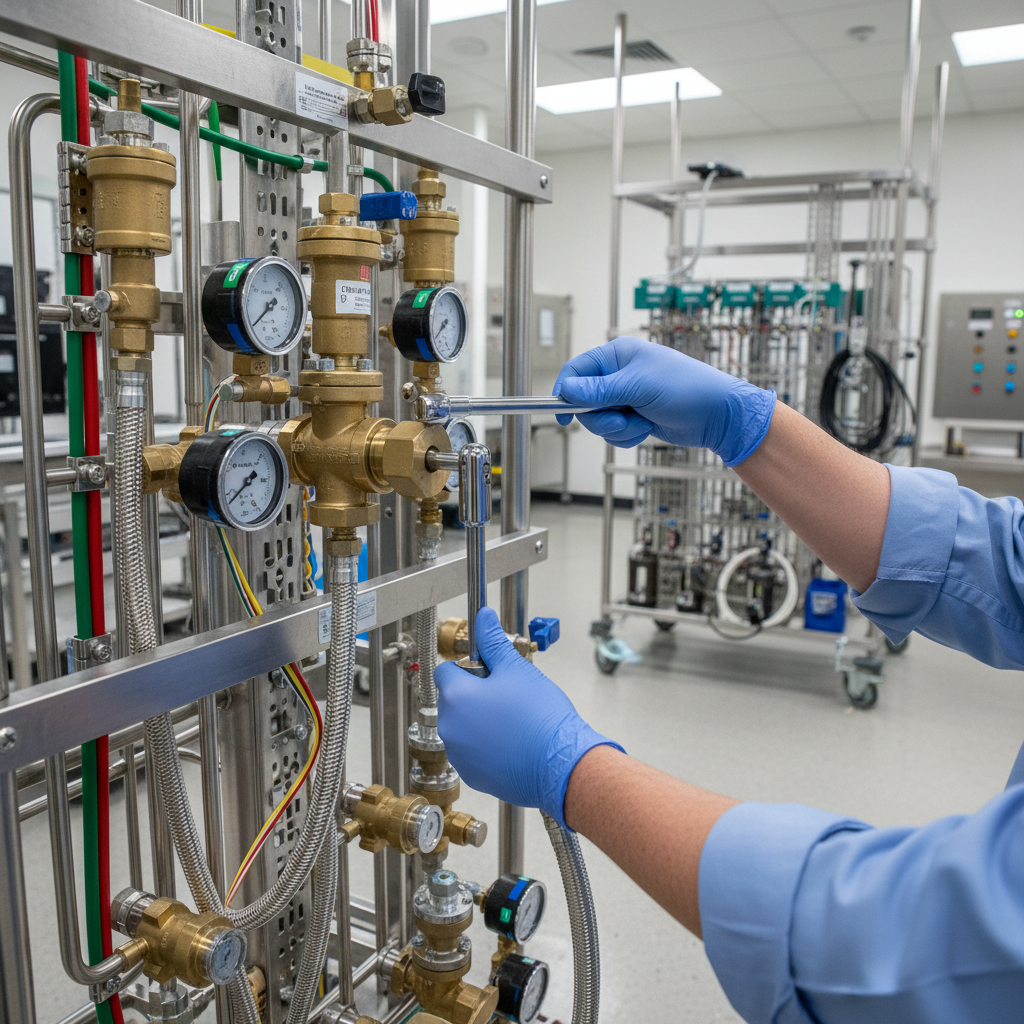
Medical Gas Maintenance Estero, FL: A Guide to System Reliability
Medical Testing SolutionsJune 24, 20267 min read
Share
Medical gas supply systems are a critical life support utility in any healthcare facility. From surgical suites to patient rooms, the uninterrupted flow of medical-grade oxygen, air, and vacuum is non-negotiable. For healthcare facilities in Estero, Florida, ensuring these systems are reliable, safe, and compliant isn't just good practice, it's a requirement. A robust preventative medical gas maintenance services plan is your first line of defense against system failure, costly emergency repairs, and regulatory penalties.
This guide provides a definitive overview of medical gas maintenance. We will explore the specific requirements outlined by NFPA 99, detail the essential maintenance tasks for core system components, and explain what to look for in a qualified service provider. By understanding the fundamentals of preventive maintenance, you can ensure your facility operates safely, efficiently, and in full compliance with national standards.
What is Medical Gas System Maintenance? (And Why It's Non-Negotiable)
Medical gas maintenance is a program of scheduled, documented, and proactive service procedures performed on all components of a facility's gas and vacuum distribution system. This includes source equipment (pumps, compressors, and manifolds), distribution piping, and patient-level components like alarms and outlets.
Unlike reactive repair work that addresses a problem after it occurs, preventive maintenance aims to identify and correct potential issues before they lead to a system failure. The stakes are incredibly high; a loss of medical vacuum during a procedure or a cross-connection in the gas lines can have catastrophic consequences for patients. For facilities in Estero and across Southwest Florida, a professionally managed maintenance program is essential for:
Patient Safety: The absolute highest priority. Properly maintained systems deliver the correct gas at the correct pressure, without contamination.
Regulatory Compliance: The Joint Commission, DNV, and other accrediting organizations (AOs) heavily scrutinize medical gas systems. Documented maintenance is a key part of any survey.
Financial Prudence: The cost of a planned maintenance visit is a fraction of the cost of an emergency call-out and the subsequent downtime, patient rescheduling, and potential legal ramifications of a system failure.
System Longevity: Like any complex mechanical system, medical gas equipment lasts longer and performs more reliably when serviced regularly.
NFPA 99 Maintenance Requirements: A Plain-English Breakdown
The National Fire Protection Association's NFPA 99, Health Care Facilities Code, is the primary standard governing medical gas systems in the United States. Chapter 5, "Gas and Vacuum Systems," outlines the specific requirements for maintenance. While the code is extensive, the core principle is the establishment of a "scheduled maintenance program" for the medical gas and vacuum systems.
Why this matters for compliance: NFPA 99 5.1.14.2, "Maintenance and Record Keeping," mandates that a risk assessment be performed and a scheduled maintenance program be established. Failure to document and perform these required tasks can result in citations during Joint Commission or DNV surveys, potentially jeopardizing accreditation and reimbursement.
Key maintenance provisions include:
Operational Integrity: The system must be maintained to ensure its operational integrity and function as originally designed and tested.
Qualified Personnel: Maintenance must be performed by individuals who are qualified and trained for the work. The industry standard for this qualification is the ASSE 6040 Medical Gas Maintenance Specialist Certification.
Documentation: Every maintenance task, test, and repair must be meticulously documented. This "paper trail" is your proof of compliance.
Core Components of a Preventive Maintenance Plan
A comprehensive maintenance contract from a company like Medical Testing Solutions will cover three main areas: source equipment, distribution alarms, and central supply systems. Our certified technicians perform comprehensive annual medical gas inspections to keep you compliant.
Maintenance Frequency Comparison Table
While manufacturer recommendations should always be followed, NFPA 99 provides minimum frequencies for many critical tasks.
Component
Task
Minimum Frequency (per NFPA 99)
Manifolds
Test automatic changeover
Per manufacturer, typically annually
Check pressure relief valves
Annually
Master Alarms
Test all signals
Annually
Area Alarms
Test all signals
Annually
Med Air Compressor
Check carbon monoxide monitor
Daily or Per manufacturer
Change oil and filters
Per manufacturer's instructions
Vacuum Pump
Change oil and filters
Per manufacturer's instructions
Outlets/Inlets
Test for flow and leaks
During planned service or as needed
Medical Gas Manifold Maintenance Checklist
The manifold is the heart of your cylinder-based gas supply, managing the transition between primary and secondary cylinder banks. Maintenance is crucial to prevent an interruption of supply.
Test Automatic Changeover: The technician will simulate the depletion of the primary cylinder bank to ensure the system automatically switches to the secondary bank and triggers the appropriate "Empty" or "Ready" alarm signal.
Inspect and Test Pressure Regulators: Ensure that line pressure is stable and matches the facility's requirements.
Check Pressure Relief Valves: Verify these critical safety devices are not compromised and will vent in an over-pressure event.
Leak Test All Connections: Inspect pigtails and fittings from the cylinders to the manifold for leaks using a suitable leak detection solution.
Medical Gas Alarm Maintenance
Master and area alarms are the nervous system of your medical gas infrastructure. They provide the critical warnings that allow staff to intervene before a problem becomes a crisis. During maintenance, a technician will:
Verify Every Signal: Each required alarm condition (e.g., "High Pressure," "Low Pressure," "Low Vacuum") is simulated at its source sensor.
Confirm Annunciation: The technician confirms that the signal is accurately displayed on both the local area alarm panel and the master alarm panel (often located in engineering or security).
Test for Accuracy: Ensure that pressure and vacuum switches trigger at the correct setpoints as defined by NFPA 99.
Medical Vacuum and Air Compressor Maintenance
These complex pieces of machinery are the workhorses of the medical gas system.
Medical Air Compressors
Maintenance focuses on ensuring the delivered air is clean, dry, and free of contaminants.
Oil and Filter Changes: Performed according to the manufacturer's recommended hours of operation.
Intake and Coalescing Filter Inspection: Clean and replace filters to ensure system efficiency and air quality.
Carbon Monoxide (CO) Monitor Test: The monitor is challenged with a test gas to ensure it alarms correctly, protecting patients from CO exposure.
Dew Point Check: Verify that the system dryers are functioning correctly and removing moisture from the air.
Medical Vacuum Pumps
For vacuum systems, maintenance is about ensuring consistent suction and pump longevity.
Oil Changes and Filter Replacement: Essential for pump health, especially for oil-based pump technologies.
Performance Testing: The technician will confirm the pump can achieve and hold the required vacuum level (typically 15-19" Hg).
Choosing a Maintenance Partner in Estero, FL
When selecting a company for medical gas maintenance, credentials are paramount. You need a partner with proven expertise and the proper certifications. Look for a provider whose technicians are ASSE 6040 Certified Medical Gas Maintenance Specialists. This certification ensures they have been trained and tested on the specific requirements of NFPA 99.
Medical Testing Solutions technicians are not only ASSE 6040 certified but have extensive field experience serving hospitals, surgery centers, and dental offices throughout the Estero and Southwest Florida area. From initial medical gas installation to ongoing support, MTS provides a full lifecycle service. After any major repair or installation, a full medical gas verification by an ASSE 6030 Certified Verifier is mandatory, a service we are fully qualified to provide. Considering a new system? Browse our products catalog for top-tier medical gas equipment.
Your Partner in Compliance and Safety
Don't wait for an alarm to sound or a system to fail. A proactive, professional medical gas maintenance program is one of the most important investments you can make for your Estero-based healthcare facility. It protects your patients, ensures compliance, and safeguards your facility's reputation.
Ready to secure your facility's compliance and patient safety? Contact Medical Testing Solutions today at +1 (754) 315-1078 or request a quote online for a customized medical gas maintenance plan for your Estero facility.
Frequently Asked Questions
Maintenance frequency is determined by NFPA 99, manufacturer guidelines, and system usage. Generally, key components like manifolds, master alarms, and source equipment require at least annual inspection, testing, and service.
According to ASSE Series 6000 standards, personnel must be an ASSE 6040 Certified Medical Gas Maintenance Specialist. The technicians at Medical Testing Solutions hold this critical certification.
Maintenance is the scheduled, preventive service and testing of existing, operational systems (overseen by ASSE 6040 personnel). Verification is a comprehensive series of tests on newly installed or modified systems *before* they are used for patient care to ensure they are safe and correct (performed by an ASSE 6030 Verifier).
While facility staff can and should perform daily observations (e.g., checking pressure gauges), NFPA 99 requires that the scheduled maintenance procedures be performed by a qualified, certified individual, such as an ASSE 6040 specialist. This ensures the tasks are done correctly and provides third-party documentation for accreditation.
Yes. While we are a key service provider for Estero and greater Collier County, Medical Testing Solutions provides medical gas services, including maintenance and emergency repairs, throughout Southwest Florida and across the state from our headquarters in Fort Lauderdale.
Request a quote for your facility
Talk with Medical Testing Solutions about your next inspection, repair or equipment request.