Medical Air Compressor Intake Flood Elevation FL: NFPA 99 & AHCA Rules
Medical Testing SolutionsNovember 13, 20269 min read
Share
Eighteen hours after a tropical storm pushed king-tide water across a coastal barrier island in South Florida, our ASSE 6030 verifier pulled the intake filter housing off a hospital’s multiplex medical air system. Four inches of brackish water sat in the bottom of the canister. The outdoor intake gooseneck had been installed at exactly 20 feet above the asphalt parking lot, technically compliant with the standard height textbook rule, yet completely vulnerable to horizontal wind-driven spray and localized storm surge pooling on a low-lying mechanical deck. Because the desiccant dryers were overwhelmed within minutes, the high dew point alarm tripped at +39°F (+4°C), forcing the facility onto emergency manifold cylinders until the entire source could be purged, repaired, and re-verified.
For healthcare facility engineers and MEP designers, understanding medical air compressor intake flood elevation FL rules requires looking past a single paragraph in the national code. In Florida, standard vertical clearance dimensions collide with FEMA Base Flood Elevations (BFE), American Society of Civil Engineers (ASCE 24) flood loads, and strict physical plant mandates enforced by the Florida Agency for Health Care Administration (AHCA). If your outdoor intake or roof penetraton allows water ingress during a Category 3 hurricane, your USP medical air source fails immediately.
NFPA 99 Intake Location and Height Rules Explained
National Fire Protection Association (NFPA) 99, Health Care Facilities Code, establishes the baseline rules for where medical air compressors draw their supply air. Under NFPA 99 Section 5.1.3.6.3.12, the medical air intake must be located outdoors above roof level, at a minimum distance of 20 feet (6.1 m) above ground level. It must also sit at least 25 feet (7.6 m) away from any ventilating system exhaust, vehicle loading dock, medical-surgical vacuum exhaust, or area where noxious fumes collect, and at least 10 feet (3.0 m) from any door, window, or other building opening.
Many engineers stop reading right there, assuming that hitting the 20-foot mark above grade satisfies the requirement. However, NFPA 99 also allows an alternative indoor intake location if an air source is available that is equal to or better than outside air, drawn from spaces with no contamination and filtered continuously. While coastal hospitals at systems like Baptist Health or Broward Health occasionally evaluate indoor intakes to avoid salt-air corrosion and hurricane spray, AHCA reviewers scrutinize indoor air sources heavily. In almost all acute care renovations across Florida, outdoor rooftop intakes remain the primary design standard.
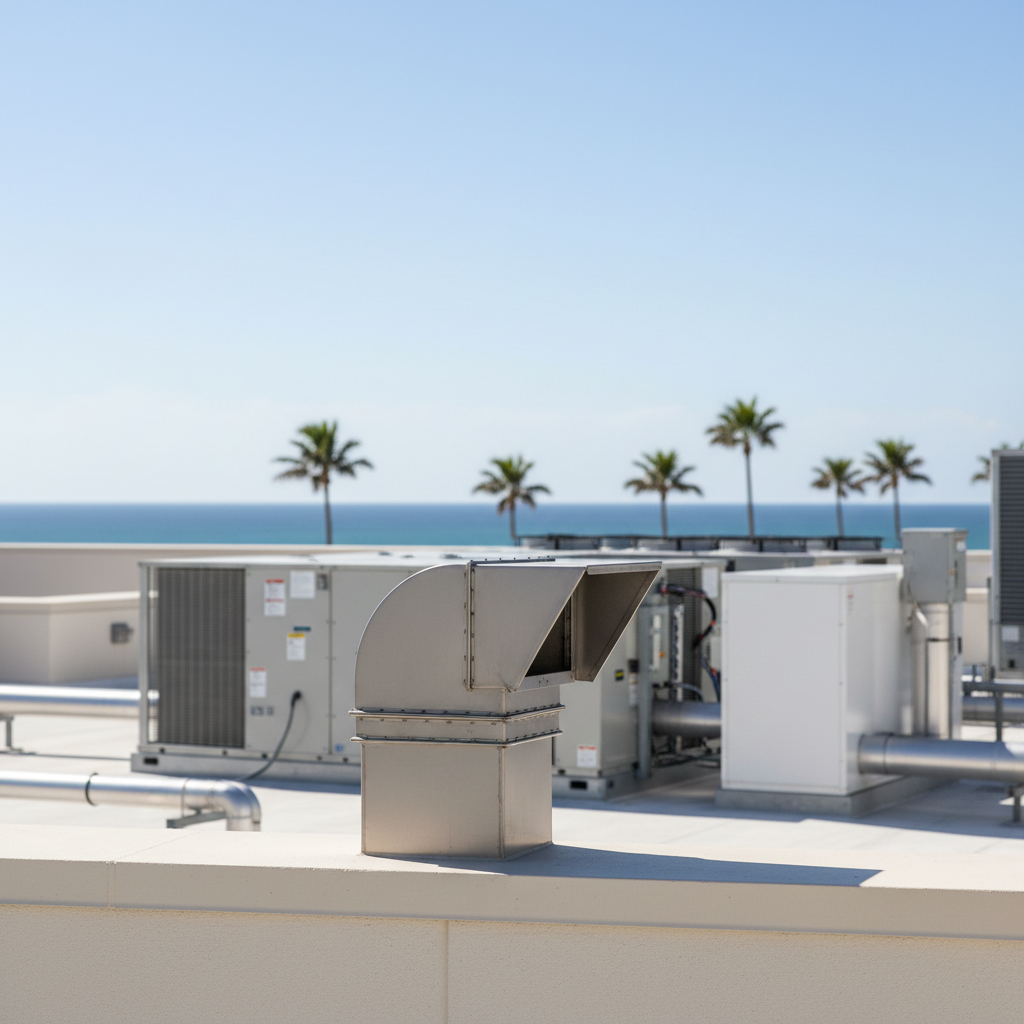
The physical orientation of the outdoor intake is just as strictly regulated. Per NFPA 99, the intake end must be turned downward and screened with non-corroding mesh (typically stainless steel) to block insects, birds, and wind-borne debris. When you factor in Florida's High-Velocity Hurricane Zones (HVHZ) in Miami-Dade and Broward counties, a simple turned-down copper gooseneck with a wire screen is rarely enough to stop horizontal rain traveling at 140 miles per hour.
Why this matters for compliance: Under Joint Commission (TJC) environment of care standards (EC.02.05.09) and AHCA state licensure surveys, any moisture bypassing your compressor intake rapidly saturates desiccant beds, spikes line dew point above the +35°F (+1.7°C) NFPA 99 alarm limit, and promotes microbial growth inside patient breathing circuits.
How AHCA Physical Plant Standards Impact Flood Elevation
In Florida, healthcare construction and major medical gas renovations fall under the jurisdiction of the AHCA Office of Plans and Construction (OPC). Your medical air system must satisfy Chapter 59A-3 of the Florida Administrative Code (for hospitals) or Chapter 59A-5 (for ambulatory surgical centers), alongside the Florida Building Code (FBC) 8th Edition.
FBC Building Section 1612 incorporates ASCE 24 (Flood Resistant Design and Construction). For coastal and flood-prone healthcare facilities, which are classified as Risk Category III or Risk Category IV buildings depending on their surgical and emergency capabilities, critical mechanical equipment and their appurtenances cannot simply reference "ground level." They must be evaluated against the Design Flood Elevation (DFE) or the 500-year flood elevation, whichever is higher.
Code / Standard
Jurisdiction / Scope
Minimum Elevation / Clearance Requirement
Primary Failure Mode Prevented
NFPA 99 (5.1.3.6.3.12)
National / Adopted by FL Fire Prevention Code
20 ft above ground; 25 ft from exhausts; 10 ft from openings; above roof level
Ground-level vehicle exhaust, loading dock fumes, and bio-aerosols
FBC / ASCE 24 (Risk Cat IV)
Florida Building Code / AHCA OPC
Base Flood Elevation (BFE) + 2 ft to 3 ft freeboard (or 500-yr flood level)
Catastrophic storm surge inundation of mechanical pads and lower air intakes
FGI Guidelines / FAC 59A-3
AHCA Physical Plant Licensure
Essential mechanical systems located above historic and projected flood levels
Total loss of life-safety medical gas supply during regional evacuation lock-ins
HVHZ Wind-Driven Rain Specs
Miami-Dade & Broward (FBC High-Velocity)
Louvered / baffled weather hoods rated for high-velocity wind-driven water
Horizontal rain bypassing standard gooseneck screens and flooding desiccant dryers
When you submit engineering plans to AHCA, reviewers verify that both the compressor skid itself and the air intake routing remain operational during a design flood event. If a hospital in Tampa (such as a BayCare or AdventHealth campus) has a ground floor situated in a Coastal A or V zone, an intake located 20 feet above physical grade might still sit perilously close to wave-crest and storm-surge spray zones if located on a low podium roof. Furthermore, upon project completion, your ASSE 6030 verifier must provide documentation that satisfies AHCA OPS Form 3110 (Health Care Facility Construction Attestation) before the state grants occupancy approval.
If you are planning a compressor replacement or relocating a vulnerable intake before storm season, schedule ASSE 6010 medical gas installation and ASSE 6030 medical gas verification with our in-state team to ensure your system passes AHCA inspection on the first walkthrough.
Engineering Intakes Against Wind-Driven Rain and Salt Air
Even when an intake clears the flood elevation by thirty feet on a hospital roof in West Palm Beach or Fort Lauderdale, South Florida weather introduces a secondary threat: atomized salt spray and horizontal rain. During a tropical cyclone, negative pressure pockets across flat hospital roofs accelerate rain droplets upward into traditional inverted-U goosenecks.
Standard copper tube intakes with brazed elbows and hardware cloth screens offer zero velocity reduction. As the medical air compressors cycle on, the suction velocity at the screen pulls suspended water droplets straight down the vertical riser. In oil-less scroll and reciprocating compressors, the standard technologies used for NFPA 99 Category 1 medical air, liquid water washes away internal PTFE coated surfaces, rusts iron valve plates, and turns desiccant beads into a hardened slurry.
To harden your medical air intake against Florida storms, facility directors and MEP engineers should implement four field-proven upgrades:
Install a low-velocity baffled weather hood: Replace simple 180-degree copper goosenecks with an oversized, flanged stainless steel weather hood featuring internal rain baffles. Oversizing the intake hood diameter drops the air entrance velocity below 500 feet per minute, allowing gravity to separate heavy rain droplets before air enters the riser.
Add a drip leg with an automatic or manual condensate trap: At the base of the vertical intake riser, right before the piping branches into the individual compressor inlet filters, install a full-size tee dropping into a capped dirt/moisture leg with a corrosion-resistant drain valve.
Specify 316L stainless steel for rooftop exposure: Within five miles of the Atlantic or Gulf coast, salt air rapidly oxidizes standard screens and brass fittings. Use 316L stainless steel insect mesh (minimum 1/4-inch to prevent clogging while blocking debris) secured with stainless bands.
Enforce strict elevation separation above flat roofs: Never terminate an intake gooseneck less than 36 inches above a flat roof membrane where clogged roof drains can cause 6 to 10 inches of ponding water during torrential downpours.
Post-Hurricane Re-Verification Under NFPA 99 5.1.12
When a major storm makes landfall near facilities like Jackson Memorial in Miami or Holy Cross Health in Fort Lauderdale, mechanical rooms and rooftop intakes take a beating. High winds can tear intake supports loose from parapet walls, and brief power transitions can cause pressure drops or moisture alarms across the medical airdryer bank.
Under NFPA 99 Section 5.1.12, any medical gas system that suffers a breach, pipeline modification, source renovation, or suspected contamination from water ingress must undergo formal verification testing before returning to patient service. You cannot simply drain the water out of the receiver tank, swap the particulate filters, and hit reset.
Post-storm verification requires an ASSE 6030 certified Medical Gas Verifier to test the source equipment and downstream piping for purity and performance. Specifically, we test the medical air system against CGA Grade D/E and USP standards, verifying that:
Dew point remains strictly below the +35°F (+1.7°C) alarm threshold at system operating pressure (50–55 psi).
Carbon monoxide (CO) levels stay below 10 ppm, confirming that emergency diesel generators running near the building are not drafted into the medical air intake.
Gaseous hydrocarbons, liquid hydrocarbons, and particulates are absent, proving that compressor rings or scroll tips did not degrade during high-humidity operation.
Local and master alarms trigger accurately at both the compressor control panel and the 24-hour monitored location.
The Local Advantage: Why Florida Facilities Choose MTS
Medical Testing Solutions is headquartered at 501 East Las Olas Blvd, Ste 300, Fort Lauderdale, FL 33301. Unlike national compliance brokers who fly verifiers in from out of state, our ASSE 6010 installers, ASSE 6020 maintainers, and ASSE 6030 verifiers live and work right here in Florida.
When you hire an out-of-state testing firm, you pay hidden markups for airfare, rental cars, hotel nights, and daily per-diem allowances. With Medical Testing Solutions, there are no travel fees, no lodging charges, and no per-diem costs anywhere in Florida. Most hospitals and surgery centers save 10% to 25% on verification and annual inspection contracts compared to out-of-state providers.
More importantly, when a hurricane passes through the state, airport closures ground out-of-state contractors for days. Our South Florida crews mobilize immediately after the storm clears to run emergency NFPA 99 5.1.12 re-verifications, replace flooded desiccant cartridges, and supply replacement compressor components. Whether you manage a mega-campus in Miami, an ambulatory surgery center in Fort Lauderdale, a coastal clinic in West Palm Beach, or a regional hospital anywhere across Florida, our local stocking and dispatch keep your operating rooms open.
Preparing Your Medical Air Intake for the Next AHCA Survey
Do not wait for a tropical storm warning or an unannounced AHCA licensure survey to find out your medical air intake sits in a ponding zone or lacks proper separation from emergency generator exhausts. Medical Testing Solutions sells commercial-grade medical gas equipment and performs turnkey ASSE 6010 installation, ASSE 6030 verification, routine maintenance, and full system certification across the entire state.
Call our Fort Lauderdale office at (754) 315-1078 for same-day dispatch in South Florida, or request a quote online to schedule your medical air intake assessment and NFPA 99 compliance verification today.
Frequently Asked Questions
Under NFPA 99 Section 5.1.3.6.3.12, outdoor medical air intakes must be located above roof level and at least 20 feet (6.1 meters) above ground level. In Florida flood zones, the Florida Building Code and ASCE 24 also require critical healthcare mechanical components to sit above the Design Flood Elevation (DFE) or 500-year flood level, whichever is higher.
The intake must be located at least 25 feet (7.6 meters) from any ventilating system exhaust, medical-surgical vacuum exhaust, vehicle loading area, or emergency generator exhaust. Additionally, it must be at least 10 feet (3.0 meters) away from any door, window, or building opening.
Yes. Under NFPA 99 Section 5.1.12, any breach of the medical gas system, source contamination, or major component repair requires formal re-verification by an ASSE 6030 certified verifier. After water ingress, the verifier must test for dew point, carbon monoxide, particulates, and hydrocarbon purity before the air source returns to patient use.
Standard 180-degree copper goosenecks with basic mesh screens allow high-velocity horizontal rain to get pulled into the intake pipe during hurricanes. Installing an oversized, baffled stainless steel weather hood reduces intake air velocity below 500 feet per minute, allowing water droplets to drop out before entering the vertical riser, while a base drip leg traps residual moisture.
Every renovation or replacement of a medical gas source in a Florida hospital or ambulatory surgical center requires inspection documentation under Chapter 59A of the Florida Administrative Code. The ASSE 6030 verification report must be completed and retained to support AHCA OPS Form 3110 (Health Care Facility Construction Attestation) prior to state occupancy approval.
Request a quote for your facility
Talk with Medical Testing Solutions about your next inspection, repair or equipment request.