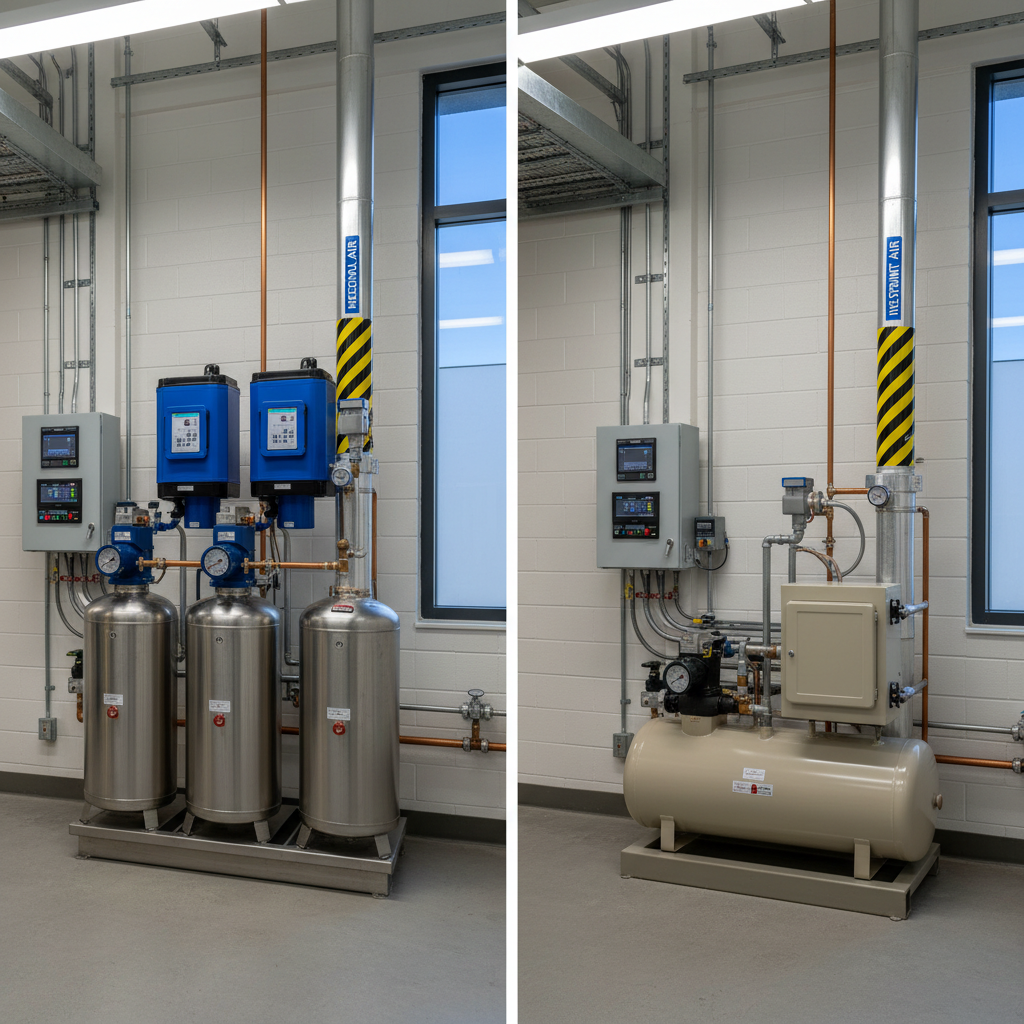
Instrument Air vs. Medical Air: A Critical Comparison for Healthcare Facilities
In a healthcare facility, compressed air is not just "air." It's a critical utility with specific applications and stringent safety standards. Two common classifications, instrument air and medical air, are often a source of confusion, yet understanding their differences is crucial for patient safety, NFPA 99 compliance, and operational integrity. While both originate from a compressor, their treatment, purification, and intended uses are worlds apart. Using the wrong type of air can introduce contaminants, damage sensitive equipment, and pose a direct risk to patients.
This guide will provide a definitive comparison based on the National Fire Protection Association (NFPA) 99 Health Care Facilities Code. We will explore the distinct requirements, acceptable use cases, and the significant risks associated with cross-contamination. By the end, you will have a clear understanding of why these two systems must be designed, installed, and maintained as separate and distinct entities, ensuring you can confidently manage your facility's medical gas systems.
What is Medical Air?
Medical air, as defined by NFPA 99, is a medical gas that is supplied from a dedicated source and intended for patient respiration and calibration of medical devices for respiratory applications. It is a life-sustaining utility, meaning patients breathe it directly. Because of this direct patient contact, the standards for medical air purity are exceptionally high and rigorously enforced.
NFPA 99 Purity & Quality Requirements
The stringent requirements for medical air are outlined in NFPA 99, Chapter 5. A medical air compressor system is not a standard off-the-shelf unit; it's a complex, multi-component assembly designed to deliver clean, dry, and contaminant-free air. Key components and requirements include:
- Dedicated Source: The compressor must be specifically designated for medical air and not used for any other purpose.
- Filtration: A sophisticated series of filters is required to remove particulates, water, and oil.
- Dryers: Redundant desiccant dryers are typically used to achieve the required low dew point, preventing moisture from entering the system.
- Monitors: A local alarm and a master alarm panel must monitor for carbon monoxide (CO) levels, dew point, and system pressure. If CO levels exceed 10 ppm or the pressure dew point rises above a set threshold, an alarm is triggered.
- Redundancy: The system must be fully redundant, ensuring a continuous supply of air even if the primary compressor or a component fails. This is often referred to as a "duplex" or "triplex" system.
Why this matters for compliance: Failure to meet these purity standards during an inspection can result in a non-compliance finding, requiring immediate and costly remediation. Regular medical gas testing and service is essential to verify that the air being delivered meets USP and NFPA 99 specifications.
Common Use Cases
- Patient Respiration: Delivered to patients via ventilators, respirators, and flowmeters.
- Neonatal ICU (NICU): Used in incubators and infant ventilators.
- Anesthesia Delivery: Blended with other medical gases like oxygen and nitrous oxide.
- Calibration: Used to calibrate respiratory therapy devices.
What is Instrument Air?
Instrument air, sometimes called "medical support gas," is compressed air used to power medical equipment and tools. It is not intended for patient respiration and does not have the same high-purity requirements as medical air. The primary concern for instrument air is protecting the sensitive internal components of the equipment it powers from moisture, oil, and particulate damage.
NFPA 99 Requirements
NFPA 99 (2018 edition, 5.1.3.6) allows for two sources for instrument air:
- A dedicated instrument air compressor: Similar to medical air, but with less stringent requirements for filtration and monitoring.
- The medical air source: Instrument air can be drawn from the medical air system before it passes through the final line regulators. This is a common and often cost-effective approach.
If a dedicated compressor is used, it must still be of a design that prevents the introduction of contaminants into the pipeline. It requires a dryer and filters but typically lacks the sophisticated CO and dew point monitors of a medical air system. The key distinction is that it's not designed or certified for human breathing.
Common Use Cases
- Powering Surgical Tools: Pneumatic drills, saws, and staplers.
- Operating Medical Equipment: Driving centrifuges, powering pneumatic brakes on equipment booms, and operating automated lab equipment.
- Ceiling Booms & Equipment Arms: Providing pneumatic power for movement and positioning.
- Central Supply: Used for cleaning and drying equipment.
Comparison Table: Instrument Air vs. Medical Air (NFPA 99)
| Feature | Medical Air | Instrument Air |
|---|---|---|
| Primary Use | Patient respiration, calibration of respiratory devices | Powering surgical tools, medical equipment |
| Patient Contact | Direct (breathing) | Indirect (powering equipment) |
| NFPA 99 Category | Category 1 (critical, life support) | Category 1, 2, or 3 (depending on risk) |
| Source Requirement | Dedicated, fully redundant medical air compressor | Can be a dedicated compressor or tapped from the medical air source |
| Purity Monitoring | Required: CO monitor, dew point monitor, alarms | Not required if sourced from medical air; dryer recommended if separate source |
| Contaminant Limits | Extremely low (e.g., CO < 10 ppm, no detectable oil) | Less stringent; focused on preventing equipment damage |
| System Redundancy | Required (duplex/triplex compressors, dryers) | Not required |
| Pipe Labeling | White text on a yellow background: "Medical Air" | White text on a yellow background with black diagonal stripes: "Instrument Air" |