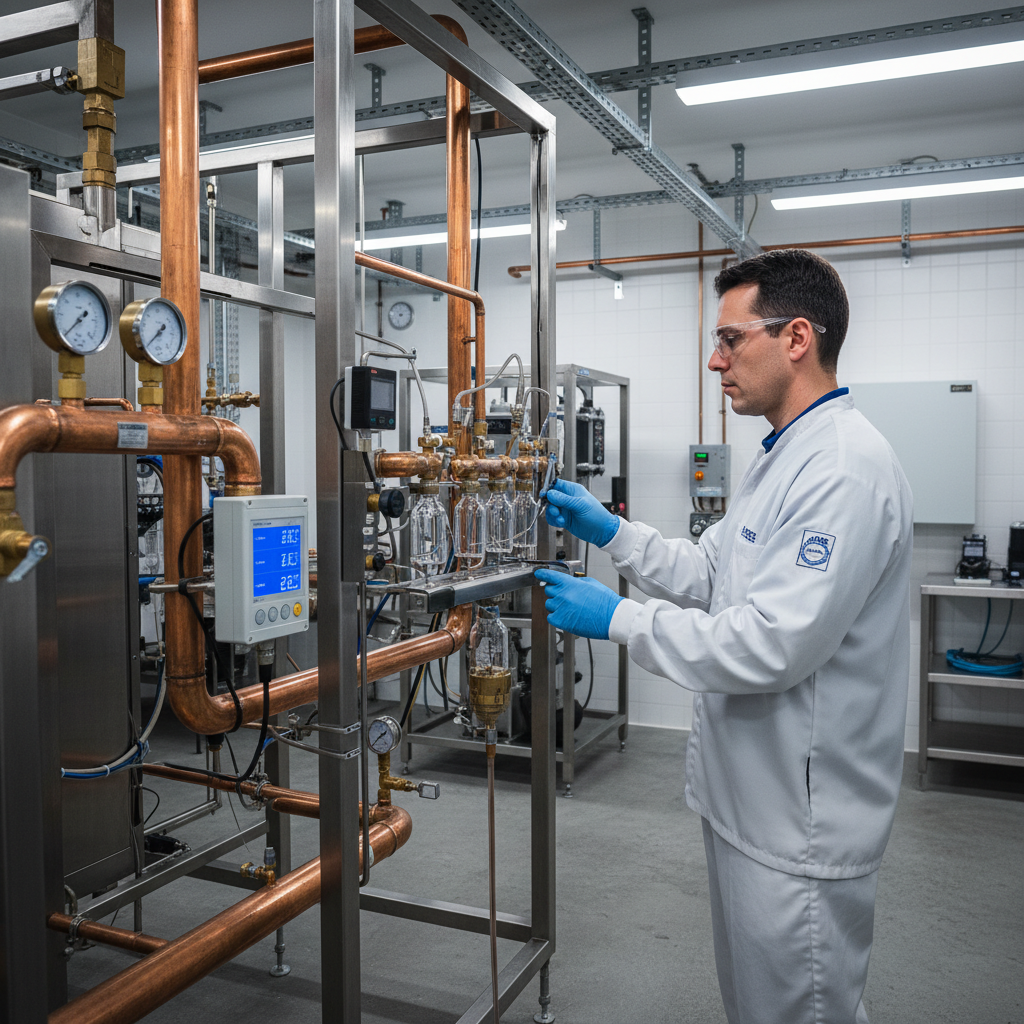
Compressed Medical Air Testing Requirements: NFPA & FDA Compliance
Medical Testing SolutionsNovember 8, 202612 min read
Share
Compressed medical air is classified by the U.S. Food and Drug Administration (FDA) as a prescription drug. Unlike ambient air or industrial compressed air, medical air (USP) enters the respiratory pathways of critically ill patients, neonates, and surgical candidates. Because it is manufactured on-site via mechanical compressor packages and distributed across extensive pipeline systems, contamination risks are continuous. To protect patients and maintain accreditation, healthcare facilities must navigate stringent compressed medical air testing requirements established by NFPA 99, the FDA, OSHA, and the Compressed Gas Association (CGA).
Meeting these standards requires a clear understanding of testing intervals, contaminant threshold limits, and source equipment operational protocols. In this guide, our ASSE-certified technicians break down the regulatory framework, gas quality parameters, sampling methodologies, and verification workflows necessary to ensure facility-wide compliance. Whether preparing for a Joint Commission survey or managing routine system maintenance, this definitive resource outlines everything required to keep medical air delivery systems safe, certified, and compliant.
The Regulatory Framework: FDA, NFPA 99, and CGA Standards
Medical air compliance is governed by overlapping federal regulations and national consensus codes. Understanding which agency enforces each requirement is essential for hospital safety directors and facility managers.
FDA & United States Pharmacopeia (USP)
The FDA regulates medical air under the Federal Food, Drug, and Cosmetic Act (21 CFR Parts 210 and 211) as a finished drug product. When medical air is produced on-site using a medical air compressor system, the healthcare facility essentially operates as a drug manufacturer. The FDA mandates that the gas delivered at the point of use meet the chemical specifications of the United States Pharmacopeia–National Formulary (USP-NF) Medical Air monograph.
NFPA 99: Health Care Facilities Code
NFPA 99 (Health Care Facilities Code) serves as the primary standard referenced by the Centers for Medicare & Medicaid Services (CMS) and deemed accrediting organizations (such as The Joint Commission, DNV, and HFAP). NFPA 99 outlines:
System design, redundancy, and physical installation requirements (Chapter 5, Section 5.1.3.6).
Minimum source equipment alarms and local instrumentation (carbon monoxide monitors, high dew point alarms).
Initial system verification standards performed under ASSE 6030 guidelines.
Periodic testing, operating logs, and facility maintenance intervals.
Compressed Gas Association (CGA) Grade D and Grade N
The Compressed Gas Association establishes commodity specifications for air under CGA G-7.1. While breathing air often adheres to CGA Grade D specifications, medical air pipeline systems must specifically meet the more stringent purity limits recognized under USP specifications, often categorized in engineering designs as CGA Grade N (Medical Air).
Why this matters for compliance: Failing to test compressed medical air according to NFPA 99 intervals does not merely jeopardize Joint Commission or DNV accreditation; it exposes a healthcare facility to federal FDA adulterated drug citations under 21 CFR § 211.165.
Medical Air USP Purity Specifications and Threshold Limits
To satisfy both FDA and NFPA standards, compressed medical air must undergo analytical laboratory testing or direct field instrument assay. The gas must meet strict limits for particulate matter, moisture, gaseous hydrocarbons, and toxic trace elements.
Contaminant / Parameter
Testing Threshold (USP / NFPA 99)
Clinical Risk & Operational Impact
Oxygen Content ($O_2$)
19.5% – 23.5% v/v
Hypoxia if below 19.5%; increased combustion/hyperoxia risks if above 23.5%.
Carbon Monoxide ($CO$)
$\le 10 \text{ ppm}$
Cellular asphyxiation; competitively binds to hemoglobin with 200x affinity of $O_2$.
Carbon Dioxide ($CO_2$)
$\le 500 \text{ ppm}$
Hypercapnia, respiratory acidosis, or indication of contaminated ambient intake.
Water Vapor (Dew Point)
Pressure Dew Point $\le 32^\circ\text{F}$ ($0^\circ\text{C}$) at 50 psig (or $\le -39^\circ\text{F}$ atmospheric)
Lipid pneumonia, oxygen-enriched fire fuel, terminal valve seat failure.
Odor
None detectable
Patient distress, administrative incident reporting, drug adulteration.
Testing Intervals: Routine Facility Monitoring vs. Annual Laboratory Analysis
A frequent point of confusion among facility operators is the distinction between automated daily monitoring and mandatory scheduled physical sampling. Compliance mandates specific intervals across both operational practices.
NFPA 99 Section 5.1.3.6.3 requires that medical air compressor systems possess continuous monitors that trigger local and master alarms:
Dew Point: A continuous hygrometer must monitor dew point at the compressor discharge. It must alarm if the pressure dew point exceeds $39^\circ\text{F}$ ($3.9^\circ\text{C}$) at 50 to 55 psig, providing early warning before reaching the regulatory failure threshold of $32^\circ\text{F}$.
Carbon Monoxide (CO): For catalytic converter systems or any mechanical compressor intake prone to vehicular or thermal exhaust contamination, continuous CO detection must alarm when levels reach or exceed $10 \text{ ppm}$.
Operating Documentation: Daily or weekly verification logs must confirm that dew point and CO monitor readouts fall within acceptable tolerances.
2. Quarterly and Semi-Annual Preventative Checks
In-house maintenance or contracted service teams must verify dryer desiccant status, condensate drain discharge cycles, coalescing filter differential pressures, and aftercooler performance every 90 to 180 days. Scheduling structured medical gas maintenance services prevents catastrophic moisture or hydrocarbon contamination before it damages the distribution piping.
3. Annual Comprehensive Quality Testing
Accrediting bodies expect full analytical verification of piped medical air at least once every 12 months. This audit entails physical gas sampling sent to an accredited third-party analytical laboratory or performed on-site by an ASSE 6030 verifier using calibrated instrumentation. Testing confirms all parameters in the table above, including trace volatile organics, hydrocarbons, carbon dioxide, and particulate matter. Facilities bundle this testing into their annual medical gas inspections to capture both source equipment operation and pipeline purity.
4. Post-Repair and Component Replacement Testing
Whenever the physical pressure boundary of a medical air system is opened (e.g., replacing desiccant dryers, rebuilding compressor pump heads, or tying in new pipeline branches), full chemical testing, cross-connection checks, and particulate purging are required before putting the equipment back into service.
Medical Air Compressor System Architecture and Sampling Locations
To understand where contamination originates, testing personnel must assess the complete design of the source equipment under NFPA 99.
| Diagram text |
|, |
Critical Sampling Points
Proper test methodology requires drawing gas from multiple locations:
Source Discharge Valve (Immediate Post-Treatment): Evaluates whether the compressor package, dryers, and filtration elements are manufacturing compliant medical air.
Farthest Terminal Outlets (Most Distant Run): Evaluates whether the distribution pipeline contains dormant copper oxides, particulate matter, moisture pockets, or biofilm.
High-Acuity Patient Zones: Testing outlets in the Intensive Care Unit (ICU), Neonatal ICU (NICU), and Operating Suites confirms delivered gas purity where patients possess the lowest physiological tolerance for trace contaminants.
Step-by-Step Procedure for Medical Air Testing
Testing medical air requires specialized sampling containers, calibrated mass-spectrometry/PID detectors, or specialized colorimetric detection tubes. When the ASSE 6030 certified verifiers at Medical Testing Solutions conduct testing, the procedure follows rigorous, standardized protocols.
Step 1: Physical Inspection of Compressor and Intake
Before sampling gas, the technician inspects the intake location. NFPA 99 mandates that intakes be located outdoors, a minimum of 25 feet from building exhausts, sewer vents, fuel storage vents, or loading docks where idling diesel trucks emit carbon monoxide and nitrogen oxides. The physical structure, intake weather hood, and screening are evaluated for degradation.
Step 2: Source Baseline Stabilization
The compressor system is brought to steady-state operational temperature under load. System pressure is stabilized, and local dew point and carbon monoxide alarms are verified for active functionality and current sensor calibration dates.
Step 3: High-Flow Purge of Testing Outlets
Before attaching precision sampling canisters or analytical sensors, the sample port and terminal outlets must be purged at high flow rates to clear stagnant gas and ambient atmospheric moisture from the pigtail adapter.
Step 4: Moisture and Dew Point Assay
Using a calibrated chilled-mirror hygrometer or electrolytic moisture analyzer, gas is sampled at full line pressure (50 to 55 psig). The technician records both the pressure dew point and the calculated atmospheric dew point to verify compliance with the $32^\circ\text{F}$ threshold.
Step 5: Direct Read Gas Analysis
Calibrated electrochemical, paramagnetic, or photoacoustic gas analyzers verify:
Oxygen concentration ($20.9% \pm 1.4%$).
Carbon monoxide ($< 10 \text{ ppm}$).
Carbon dioxide ($< 500 \text{ ppm}$).
Step 6: Laboratory Canister or Sorbent Tube Collection
For trace hydrocarbons, halogenated solvents, and volatile organic compounds (VOCs), a certified high-pressure sample container or evacuated passivated stainless-steel canister is filled using a cleanliness-certified regulator assembly. The sample is tracked through a formal chain of custody to an ISO 17025 accredited gas laboratory.
Step 7: Particulate and Oil Contamination Swabbing
A known volume of gas is passed through a membrane filter disc to measure particulate mass and check for particulate matter larger than 1 micron. The disc is inspected gravimetrically and under magnification to ensure zero residual lubricant or metal shavings from compressor wear.
Common Causes of Air Quality Failures and Corrective Actions
When a medical air sample fails compliance testing, facility leadership must act rapidly to identify root causes and isolate affected pipeline zones.
1. Elevated Carbon Monoxide ($> 10\text{ ppm}$)
Root Cause: Intake air contamination is the most frequent culprit. Shifts in prevailing winds can draw idling delivery vehicle exhaust, boiler flue gases, or helicopter pad fumes into the outdoor intake hood. Another source is internal thermal breakdown of synthetic lubricants in legacy reciprocating compressors.
Action: Inspect the intake perimeter. If the intake cannot be relocated, install catalytic carbon monoxide converters. In systems utilizing oil-lubricated compressors (permitted under older editions of NFPA 99 with high-temperature cutouts), replace failing piston rings and thermal sensors immediately.
2. High Dew Point / Moisture Breakthrough ($> 32^\circ\text{F}$)
Root Cause: Saturated desiccant beds in twin-tower heatless dryers, malfunctioning purge valves, failed auto-drain solenoids on the receiver tank, or an overloaded aftercooler.
Action: Rebuild dryer switching valves and replace saturated molecular sieve or activated alumina desiccant. Inspect the receiver tank auto-drain to ensure accumulated liquid discharges automatically. If water has entered the copper piping, an extensive pipeline drying and inert gas purging protocol must be executed under ASSE guidelines.
3. Elevated Carbon Dioxide ($> 500\text{ ppm}$)
Root Cause: Ambient outdoor atmospheric air in dense metropolitan areas or proximity to cooling towers, HVAC exhaust plenums, or parking structures.
Action: Evaluate atmospheric conditions near the air intake. Install regenerative CO2 adsorbers or relocate the intake stack vertically above the building's thermal wash layer.
4. Particulate Matter and Pipe Scale
Root Cause: Degraded final line filters (after-filters), failing desiccant dusting without downstream capture, or copper oxidation due to brazing without an internal nitrogen purge during past renovations.
Action: Replace 1-micron particulate filters immediately. Where construction has taken place, validate that all work complied with medical gas installation requirements (ASSE 6010), which require a continuous nitrogen purge to prevent interior black cupric oxide flaking.
Documentation, Traceability, and Accreditation Audits
A pristine medical air system can still trigger Joint Commission or CMS condition-level deficiencies if documentation is incomplete. Surveyors expect comprehensive, unbroken operational logs.
To withstand scrutiny during life safety and environment of care surveys, maintain the following records on file for a minimum of 3 to 5 years:
Annual Analytical Certificates: Detailed laboratory reports confirming all USP chemical parameters with method detection limits clearly marked.
Monitor Calibration Records: Proof that in-line carbon monoxide monitors and dew point hygrometers are calibrated annually using certified calibration span gases.
Technician Credentials: Copies of the inspecting technician’s ASSE 6030 or ASSE 6040 credentials. Facilities should never allow uncertified contractors to sign off on medical gas purity.
Maintenance Logs: Invoices and work orders detailing filter element replacements, desiccant changes, valve replacements, and lubrication schedules.
When facility managers need a turn-key solution, Medical Testing Solutions delivers comprehensive reporting packets that cross-reference NFPA 99 Chapter 5 guidelines line-by-line, providing documentation that passes accreditation audits without delay.
Verifying Systems After Modification or Construction
Any physical alteration to a medical air distribution network introduces contamination risks. NFPA 99 Section 5.1.12 dictates that before any modified system is utilized for clinical care, complete medical gas verification must be completed by an independent ASSE 6030 verifier.
Scope of Post-Modification Verification
Cross-Connection Testing: Proving that medical air outlets are not crossed with medical vacuum, nitrous oxide, nitrogen, or oxygen lines.
Purge Testing: Running high-volume flushes to purge particulate matter accumulated during installation.
24-Hour Standing Pressure Test: Testing piping at 20% over normal working pressure (60 psig for a 50 psig system) to validate that no microscopic leaks exist.
Final Purity Analysis: Sampling outlets downstream of the modification to verify that soldering, brazing fluxes, or atmospheric air have not compromised medical air purity.
For broader system overhauls, including overall facility licensing and expansions, coordinating medical gas certification early in the architectural and contracting process avoids costly construction delays and prevents project sign-off roadblocks.
How Medical Testing Solutions Ensures Full Compliance
Navigating compressed medical air testing requirements requires qualified partners with proper credentials and deep field experience. Medical Testing Solutions provides comprehensive testing, equipment, and consulting services designed to keep medical gas systems fully compliant and clinical environments safe.
ASSE 6030 Certified Verifiers: Our field testing specialists hold national ASSE credentials and use calibrated, clinical-grade analyzers to conduct on-site testing.
Equipment and Replacement Infrastructure: In addition to testing services, Medical Testing Solutions distributes medical gas equipment through our products catalog, supplying replacement filtration elements, dew point sensors, CO monitors, and medical compressor parts.
Comprehensive Testing Bundles: We integrate medical air quality testing into complete facility compliance programs, auditing line isolation systems, gas purity, alarm panels, and terminal outlets under a single scope of work.
If your facility requires immediate compliance testing, emergency troubleshooting for elevated dew point alarms, or upcoming accreditation testing, contact us or call directly at (754) 315-1078 to speak with an ASSE-certified specialist.
Frequently Asked Questions
While CGA Grade D breathing air is suitable for industrial respiratory equipment and SCBA applications, Medical Air USP is classified as a manufactured prescription drug governed by FDA monographs and NFPA 99. Medical Air USP requires strict limits on water vapor (pressure dew point not exceeding 32°F at 50 psig), total hydrocarbons (<= 25 ppm), carbon dioxide (<= 500 ppm), and complete absence of oil mist and odor.
NFPA 99 mandates continuous in-line monitoring of dew point and carbon monoxide at the source equipment discharge. In addition to daily operational monitoring, third-party analytical laboratory testing of gas purity at outlets and source valves must be conducted annually, or immediately following any mechanical repair, filter change, or pipeline expansion.
Medical air compliance testing must be executed by certified personnel holding credentials under the ASSE 6000 Professional Qualifications Standard—specifically an ASSE 6030 Medical Gas System Verifier or an ASSE 6040 Medical Gas Maintenance Person. General facility maintenance staff or industrial compressor vendors without ASSE credentials do not satisfy the qualification requirements set by CMS and The Joint Commission.
First, verify whether the alarm reflects true carbon monoxide elevation (10 ppm or higher). Switch to your secondary emergency medical air source (such as high-pressure cylinder reserve manifolds) to protect downstream patients. Immediately inspect the outdoor intake stack for idling delivery trucks, roofing equipment, or nearby combustion exhaust. Contact an ASSE-certified service company to sample system discharge and calibrate instrumentation before resetting.
Under NFPA 99 Section 5.1.3.6.3.8, compressor intakes must be piped outdoors and located a minimum of 25 feet away from all engine exhaust outlets, building ventilation exhausts, plumbing vents, loading docks, and generator flues. The intake must be turned downward, fitted with non-corroding insect screening, and placed at least 20 feet above ground level to minimize intake of dust and exhaust.
Request a quote for your facility
Talk with Medical Testing Solutions about your next inspection, repair or equipment request.